Starting a jewelry business today is easier than ever. With online platforms, accessible tools, and global demand for unique designs, anyone with creativity and determination can turn jewelry into a real business.
However, the barrier to entry being low also means competition is higher than before. Success doesn’t come from just making beautiful pieces—it comes from choosing the right niche, building a clear strategy, and understanding how to move from idea to setup, sales, and long-term growth. This guide will walk you through the entire process step by step.
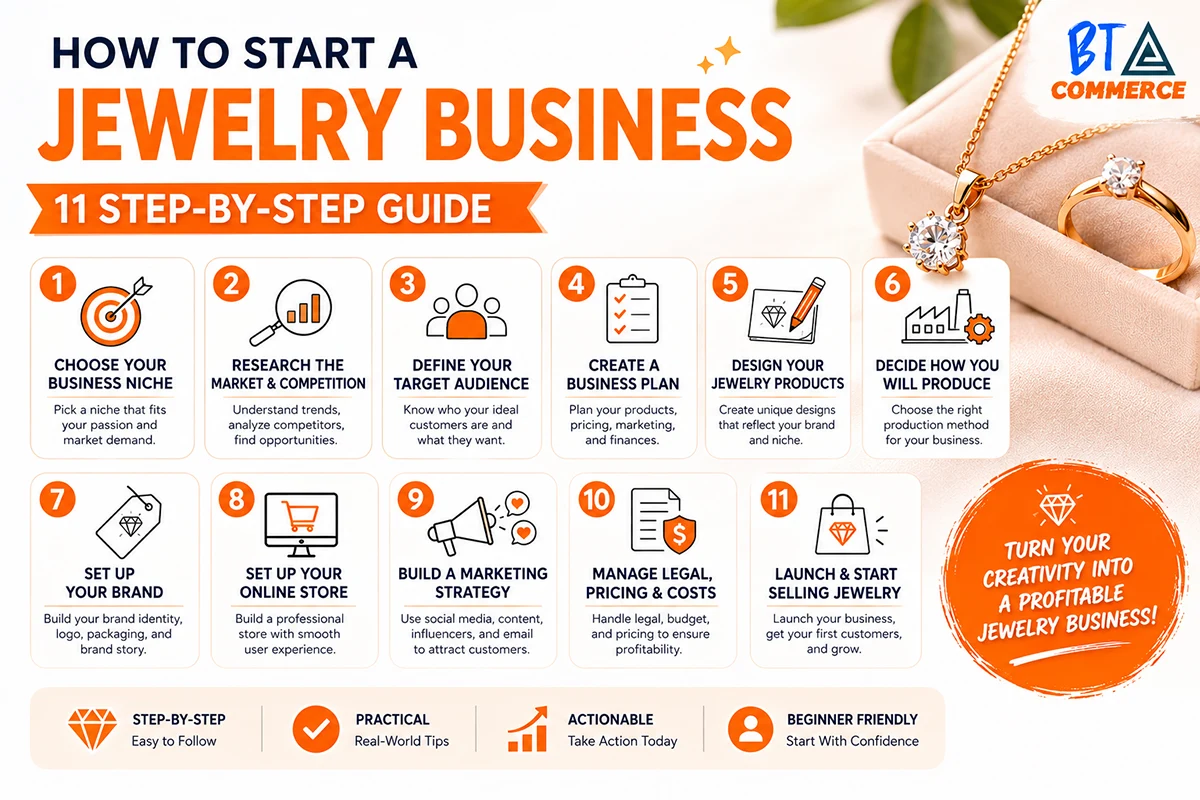
Step 1. Choose Your Jewelry Business Niche
Choosing the right niche is the foundation of a successful jewelry business. It helps you stand out in a crowded market, attract the right customers, and build a brand that feels clear and memorable. Instead of trying to sell to everyone, focusing on a specific direction allows you to position your products more effectively and grow faster with less wasted effort.
Popular jewelry business models
Before starting, it’s important to understand the main types of jewelry businesses you can build:
- Handmade jewelry: Unique, artisan-style pieces made by hand such as beading, wire wrapping, or metalwork. This model is strong for storytelling and branding, but scaling may require additional help or production support.
- Fine jewelry: High-value pieces made from precious metals like gold or platinum and genuine gemstones. It offers higher profit margins but requires more capital, expertise, and trust-building.
- Custom jewelry: Personalized designs such as engraved names, birthstones, or made-to-order pieces. This niche is highly in demand because personalization adds emotional value.
- Fashion / costume jewelry: Trend-driven and affordable pieces designed for mass appeal. It’s easier to start and test the market quickly, often using non-precious materials.
=> Read more:
- 100+ Small Business Ideas (Low-Cost & Profitable)
- 20 Clothing Business Ideas That You Can Start Today
- How to Start a Business in 10 Practical Steps to Succeed
How to choose the right niche
Selecting the right direction depends on balancing your strengths, resources, and target market. A structured way to decide includes:
- Skill: Consider your ability in design, craftsmanship, or digital tools like CAD. Your skill level will directly influence what type of jewelry you can realistically produce.
- Budget: Fine jewelry requires higher upfront investment, while fashion or handmade jewelry can start with much lower costs.
- Target customer: Define who you are selling to—luxury buyers, gift shoppers, or everyday fashion users. Understanding their needs will guide your product style, pricing, and branding direction.
By combining these factors, you can narrow down a niche that is not only realistic to start with but also has long-term growth potential.
Step 2. Research the Market and Competition
Researching the market and competition is a critical step before starting a jewelry business. It helps you understand what customers are currently buying, which trends are growing, and where your brand can realistically compete. Instead of guessing, you base your decisions on actual demand and competitor behavior, which significantly reduces risk when launching.
A proper research process also helps you identify gaps in the market. By analyzing existing brands, pricing models, and customer feedback, you can position your jewelry business in a way that feels more unique and targeted rather than entering an overcrowded space with no clear direction.
Understand jewelry trends
Understanding current trends gives you insight into what is actually selling in the market and what customers are actively searching for.
- Online jewelry growth: Jewelry sales are increasingly shifting to online platforms, including eCommerce stores and social media channels. This makes digital presence and content strategy an important part of any new jewelry business.
- Personalized jewelry demand: Custom pieces such as engraved rings, name necklaces, and birthstone jewelry are in high demand because they carry emotional meaning and feel more personal to buyers.
These trends help you validate your direction early and focus on product ideas that already have proven interest.
Analyze competitors
Competitor analysis helps you understand how existing jewelry brands operate and what makes them successful in a competitive market.
- Pricing strategy: Study how competitors price their products based on materials, craftsmanship, and brand positioning. This gives you a realistic benchmark for your own pricing.
- Product positioning: Identify whether they target luxury customers, everyday fashion buyers, or niche segments like handmade or sustainable jewelry.
- Branding style: Observe how they build their visual identity, tell their brand story, and present their products across websites and social media.
By combining trend research and competitor insights, you can define a clearer direction for your jewelry business and build a stronger, more differentiated brand from the beginning.
Step 3. Define Your Target Audience
Defining your target audience means identifying the specific group of people most likely to buy your jewelry. Instead of designing for everyone, focus on a clear niche such as minimalist everyday wear, luxury fine jewelry, or statement pieces. This helps you make better decisions about design, pricing, and marketing from the start.
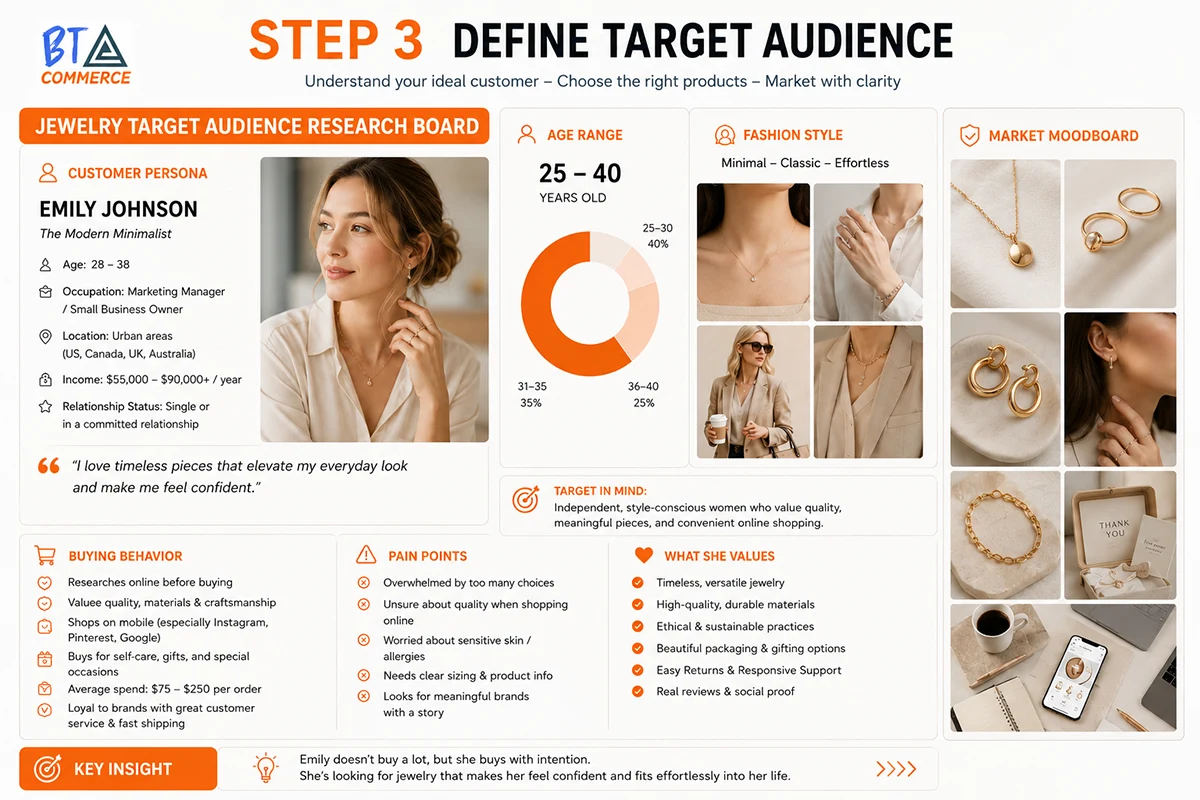
To define your audience, focus on what you sell, who is already buying similar products, and how they make purchasing decisions.
- Start from your product: your materials, price range, and style (minimalist, luxury, boho, statement) will naturally determine your target customers
- Look at real market behavior: check competitors on Etsy, Instagram, or Shopify and observe who engages with similar jewelry and what customers are saying in reviews
- Identify basic customer traits: age range, lifestyle, budget level, and shopping habits (impulse vs research-driven buyers)
- Validate with early sales: launch a small test collection (8–12 pieces), see what sells first, and adjust your direction based on real customer feedback
This step doesn’t need to be perfect—it just needs to be clear enough to guide your first product and marketing decisions.
Step 4. Create a Jewelry Business Plan
A jewelry business plan is the blueprint that turns your idea into a real, structured business. It helps you define your niche, pricing, target customers, marketing direction, and financial plan in a clear and practical way. Even if you are starting small, having a business plan keeps you focused, reduces risks, and makes it easier to grow step by step.
This plan is not only useful for investors or loans, but also acts as your internal roadmap. It ensures every decision—from what products to make, how to price them, to how you sell and market—follows a consistent direction.
A simple but effective jewelry business plan should include:
- Executive summary & vision: Define what you are building and where you want to go. This could be a handmade local brand, a luxury fine jewelry label, or a global online jewelry store. Clarify your mission, core values, and brand identity so your direction stays consistent.
- Products and pricing strategy: Clearly describe what you sell (handmade, fine, custom, or fashion jewelry). Then calculate your full cost, including materials, labor, packaging, and shipping, to set a pricing structure that ensures profit while staying competitive.
- Target market and competition: Identify exactly who your ideal customers are—their style, budget, and buying behavior—and analyze competitors to understand how you can differentiate your brand in the market.
- Marketing and sales channels: Decide where you will sell your products, such as your own website, Etsy, social media platforms, or local markets. At the same time, plan how you will attract customers through content, social media, influencers, or email marketing.
- Financial plan and operations: Estimate your startup costs, fixed expenses, and cash flow. This helps you understand how much capital you need and how your business will stay financially sustainable in the early stages.
A well-structured business plan gives you clarity and direction, helping you move from idea to execution with confidence and avoid random or emotional decision-making.
Step 5. Design Your Jewelry Products
Designing your jewelry products is the stage where your idea becomes a real, sellable collection. Instead of creating random pieces, you need to build a clear and cohesive design direction that reflects your brand identity and appeals to your target audience. A strong design strategy ensures your products feel consistent, recognizable, and market-ready.
The goal is not just to make beautiful jewelry, but to create a collection that tells a story and can be sold as a complete brand experience.
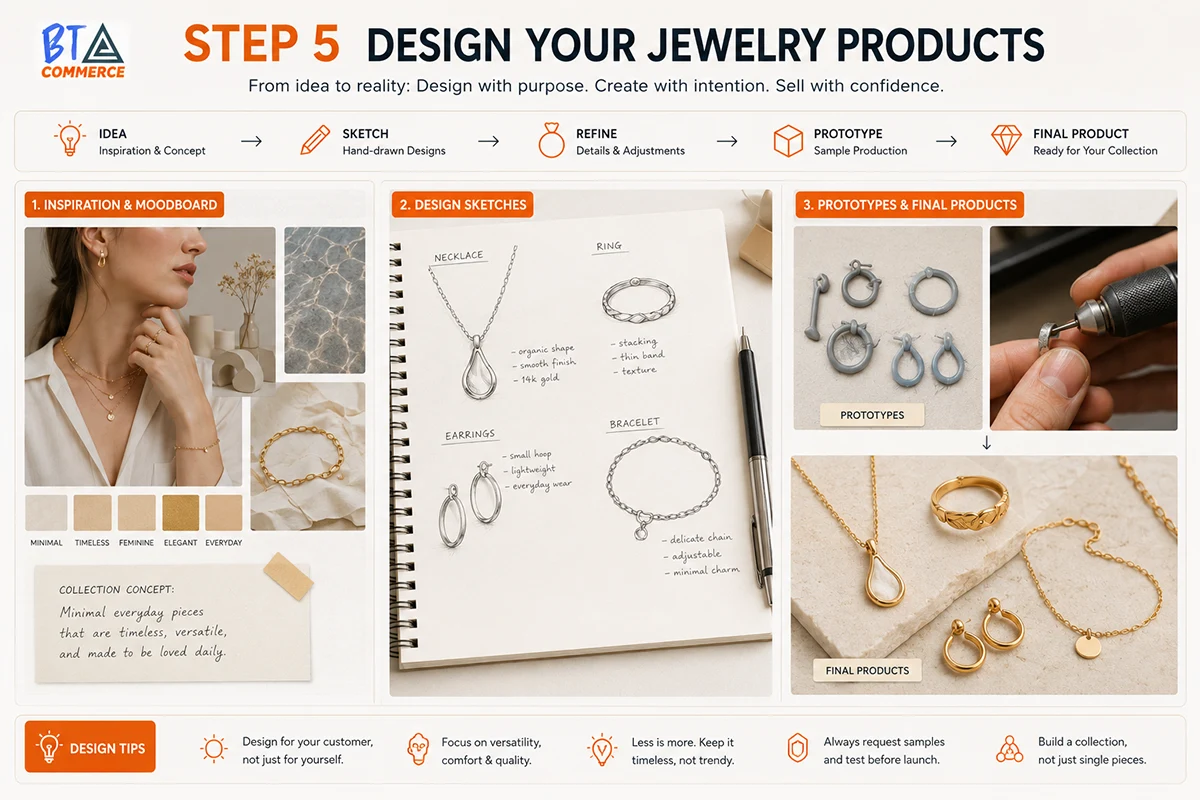
A structured approach to designing your jewelry products includes:
- Find your signature aesthetic: Start by defining your niche style such as minimalist, boho, vintage, luxury, or statement jewelry. Create a mood board with inspiration images, colors, and textures to ensure your designs follow a consistent visual direction.
- Build a cohesive collection: Instead of launching many unrelated pieces, start with a small curated collection of around 8–12 items. Design pieces that work individually but also complement each other, such as matching sets, stackable rings, or coordinated earrings and necklaces.
- Draft and refine your designs: Begin with simple hand sketches to quickly visualize ideas, then refine them into more detailed versions. For more complex or fine jewelry, you can use CAD tools or work with a 3D designer to turn sketches into accurate digital models.
- Choose materials strategically: Select materials that match your pricing and target market, such as sterling silver, gold-filled metals, stainless steel, or semi-precious stones. Your material choices should balance quality, aesthetics, and profitability.
- Test and prototype your pieces: Before full production, create samples to evaluate weight, durability, comfort, and appearance in real life. This step helps you avoid design flaws and ensures your jewelry is actually wearable.
- Document your creation process: Capture behind-the-scenes photos and videos of sketching, sourcing materials, and building prototypes. This content can later be used for marketing and helps build anticipation before launch.
A well-designed jewelry collection is not only visually appealing but also strategically built to sell, scale, and strengthen your brand identity.
Step 6. Decide How You Will Produce Jewelry
How you choose to produce your jewelry will directly impact your startup costs, profit margins, and how easily you can scale your business later. There is no single “best” option—your decision should depend on your budget, niche, and how much control you want over quality and production.
At this stage, you need to choose a production model that matches your business goals, whether that is handmade craftsmanship, outsourced manufacturing, or a hybrid approach.
Common production options include:
- In-house handcrafting: You produce the jewelry yourself, making this ideal for handmade, bespoke, or fine jewelry brands. It gives you full control over quality and design, and allows you to market your products as truly handmade. However, it is time-consuming, harder to scale, and requires investment in tools and workspace.
- Print-on-demand (POD) & dropshipping: A supplier manufactures and ships products directly to your customers. This model works well for beginner-friendly or trend-based jewelry businesses because it requires very low upfront investment and no inventory. The downside is lower profit margins and limited control over product uniqueness and quality.
- Local manufacturing partners: You work with nearby studios or jewelers to produce your designs. This is a strong option for mid-to-high-end jewelry because it offers better communication, easier quality control, and supports an “ethical/local production” brand image. However, costs are higher and often require bulk orders.
- Overseas manufacturing: Factories (often in Asia) handle large-scale production at lower costs. This model is ideal for scaling and maximizing profit margins, especially for fashion jewelry. However, it often involves minimum order quantities, longer communication cycles, and less direct quality control.
Once you choose a direction, the next step is to evaluate your cost structure carefully. Make sure your pricing covers materials, production, packaging, and still leaves a healthy profit margin. If you outsource production, always order samples first to check quality before committing to bulk orders.
Step 7. Set Up Your Jewelry Brand
At this stage, you’re turning your jewelry into a real brand, not just individual products. A strong brand makes you look more professional, builds trust faster, and increases perceived value even when you’re just starting. The key is consistency across everything customers see and experience.
Start by defining your brand foundation:
- Choose your niche: Keep it focused (minimalist, luxury, handmade, or custom jewelry) so your brand is easy to position.
- Create a simple brand story: Why you started and what your jewelry represents (keep it short and clear).
- Define your brand tone: Decide how your brand “sounds” (elegant, modern, romantic, bold) and stay consistent everywhere.
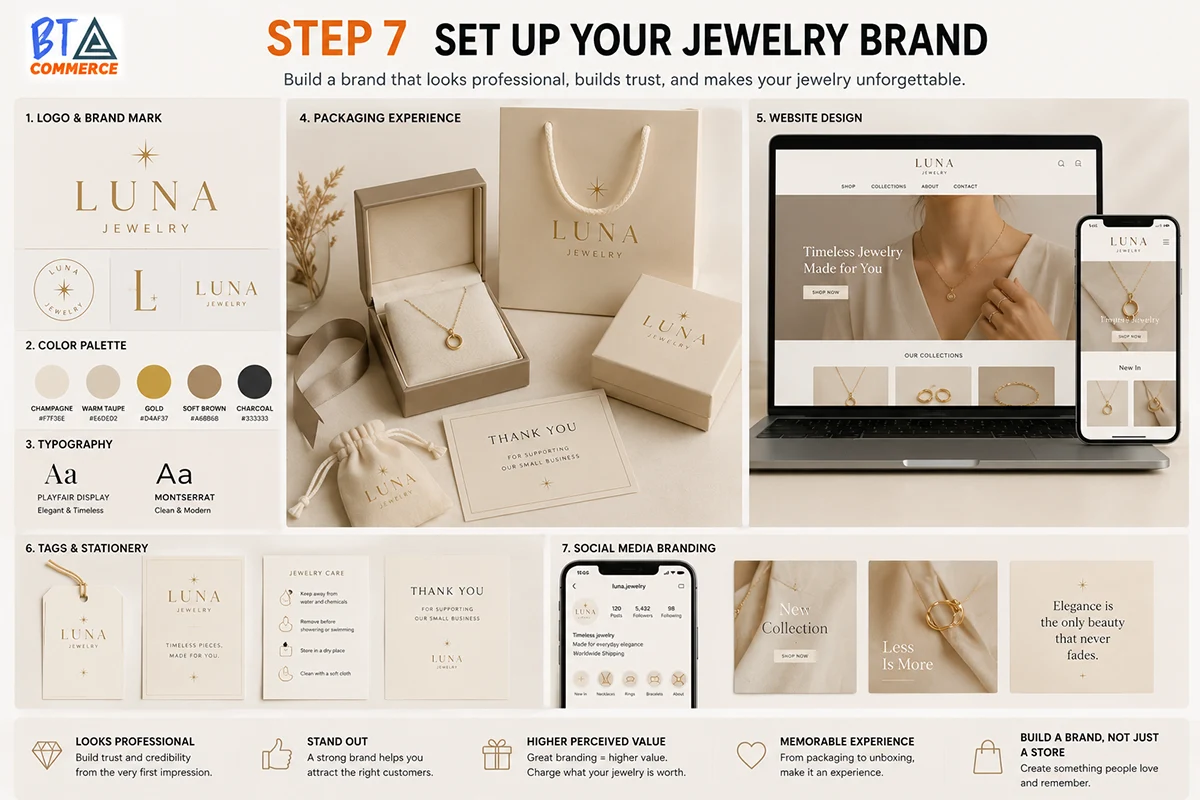
Next, build a basic visual identity:
- Logo: Simple and clean, usable on tags, website, and packaging
- Colors: Stick to 2–3 main colors that match your niche
- Fonts: Use only 1–2 fonts for consistency
- Packaging: Boxes or pouches + small touches like thank-you cards to increase perceived value
Then set up the business basics:
- Register your business name (if required in your country)
- Complete tax or sales setup if needed
- Open a separate business bank account to track money clearly
=> Read more: 500+ Jewelry Business Name Ideas for Stores & Brands
Finally, define customer policies:
- Shipping time: Be clear about delivery time (especially for handmade/custom orders)
- Returns/exchanges: Simple and transparent rules
- After-sales support: Basic repair or assistance policy if applicable
A strong jewelry brand is built on consistency. When your identity, visuals, and customer experience align, your business instantly feels more trustworthy and easier to grow.
Step 8. Set Up Your Online Jewelry Store
Your online store is where customers discover your jewelry and decide whether to buy. It needs to be clear, trustworthy, and optimized for conversion, because even small details can directly affect sales.
- Choose your eCommerce platform: Shopify is best for building a scalable, professional brand; Etsy is ideal for beginners or handmade jewelry with built-in traffic; WooCommerce works well if you want full control and already use WordPress
- Build strong product presentation: Use high-quality photos with good lighting, show multiple angles (close-up, front, and worn), and keep backgrounds clean and consistent to make your store look professional
- Write clear product pages: Include materials, size, weight, and key details; use simple SEO keywords customers search for; and add basic care instructions to increase trust
- Set up a smooth checkout process: Enable trusted payments like PayPal, credit/debit cards, Apple Pay, or Shop Pay; keep checkout simple; and clearly show shipping and return policies before payment
- Add trust and marketing elements: Use customer reviews, email signup discounts, and connect your store with Instagram, TikTok, or Pinterest to drive traffic and increase sales
A clear and simple store structure helps customers trust your brand faster and makes the buying process easier.
=> Read more: How to Start an Online Business (8-Step Beginner Guide)
Step 9. Build a Marketing Strategy for Jewelry Business
Your marketing strategy should focus on reaching the right audience and turning visual content into consistent sales. Jewelry is highly visual, so the goal is to show your products in a way that creates desire, trust, and engagement.
- Define your target audience: choose clearly between niches like minimalist (professionals), luxury buyers, or Gen Z fashion customers so your content and tone stay consistent
- Use Instagram, TikTok, Pinterest as your main channels: focus on visual content like product close-ups, styling videos, behind-the-scenes creation, and “how to wear” ideas
- Build storytelling content, not just product posts: show inspiration, craftsmanship, and how each piece fits into a lifestyle
- Encourage user-generated content (UGC): ask customers to share unboxing videos or photos wearing your jewelry, then repost to build social proof
- Build an email list early: offer small incentives like discounts and use it for product launches, restocks, and styling updates
- Collaborate with micro-influencers: reach niche audiences with high engagement through gifted products or paid posts
- Run paid ads (Meta/Google) when ready: combine awareness campaigns with retargeting ads for visitors who didn’t purchase
Focus on consistency: visual content, repetition, and trust-building are what turn casual viewers into long-term customers.
Step 10. Manage Legal, Pricing, and Startup Costs
This step helps you set up your jewelry business legally, control your budget, and price your products correctly so you can operate safely and profitably.
- Set up legal basics: register your business (LLC or local equivalent if available), get a business license, and complete tax registration so you can sell legally
- Understand compliance rules: ensure product details like metal stamps (925, 14k) and descriptions are accurate to avoid legal issues
- Protect your business: consider basic insurance to cover inventory, tools, and liability risks
- Plan your startup budget:
- Home-based setup: around $500–$2,000 for tools, materials, packaging, and basic setup
- Physical store: around $9,000–$30,000+ for rent, equipment, and store setup
- Key costs include materials, tools, packaging, branding, and eCommerce platform fees
- Set your pricing strategy: calculate total cost (materials + labor + packaging + overhead)
- Apply a simple rule: price your products at 2.5x–3x your total cost for retail
- If selling wholesale, use around 2x cost so retailers can still profit
Getting your legal setup, costs, and pricing right from the beginning ensures your jewelry business is safe, profitable, and scalable—not just creative.
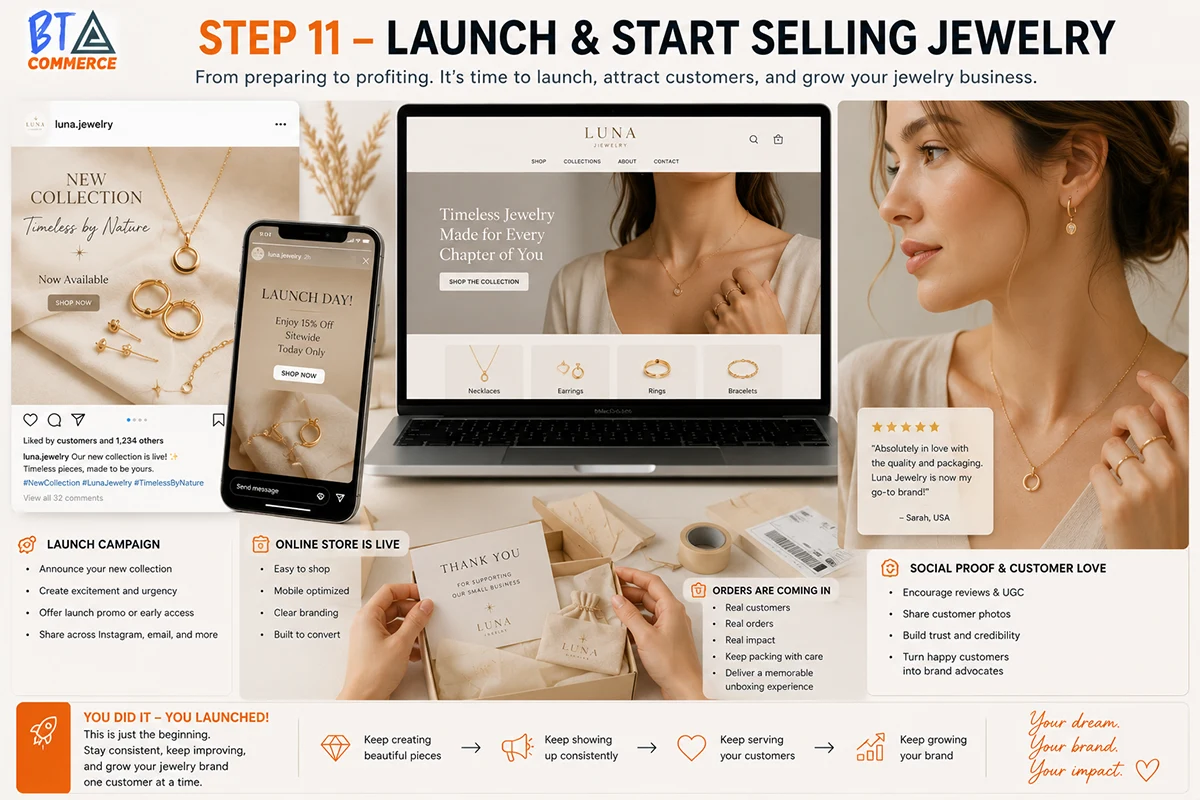
Step 11. Launch and Start Selling Jewelry
This is the stage where your jewelry business goes live. The goal is to create strong early momentum, attract your first buyers, and turn initial attention into real sales.
- Choose your selling channels wisely: start with your own website (Shopify or Squarespace) if you want long-term brand control, use Etsy to get faster early traffic from ready-to-buy customers, and add pop-ups or local markets to build trust and get real feedback
- Build anticipation before launch: share behind-the-scenes content (design, packaging, process), post sneak peeks of your collection, and collect emails early with incentives like early access or a small discount
- Make your launch feel like an event: use limited-time offers (free shipping, small gifts, discount codes), and create urgency with limited stock or a short launch window to encourage fast decisions
- Focus on strong product presentation: use clean, high-quality photos with good lighting, show jewelry being worn to demonstrate size and fit, and write clear descriptions including materials, sizing, and care instructions
- Optimize post-purchase experience: use thoughtful packaging (boxes or pouches), add a small thank-you note, and follow up after delivery to collect feedback or reviews and encourage repeat purchases
A successful launch is not about perfection—it is about momentum, trust, and making it easy for customers to buy and come back.
A jewelry business is a balance of creativity and strategy. Start small, test quickly, and grow based on real customer demand—not assumptions. In the long run, focus on building a strong brand and earning trust, because these are what turn simple products into a sustainable business.
Recommended Reading