Starting a t-shirt business is an accessible way to enter the ecommerce industry, allowing entrepreneurs to sell custom apparel through models like print-on-demand, dropshipping, or direct production. With the right niche, unique designs, reliable suppliers, and effective marketing strategy, a t-shirt brand can grow into a profitable online business.
In this guide, BTA Commerce will walk you through how to start a t-shirt business, from planning and product creation to launching your store and scaling your brand.
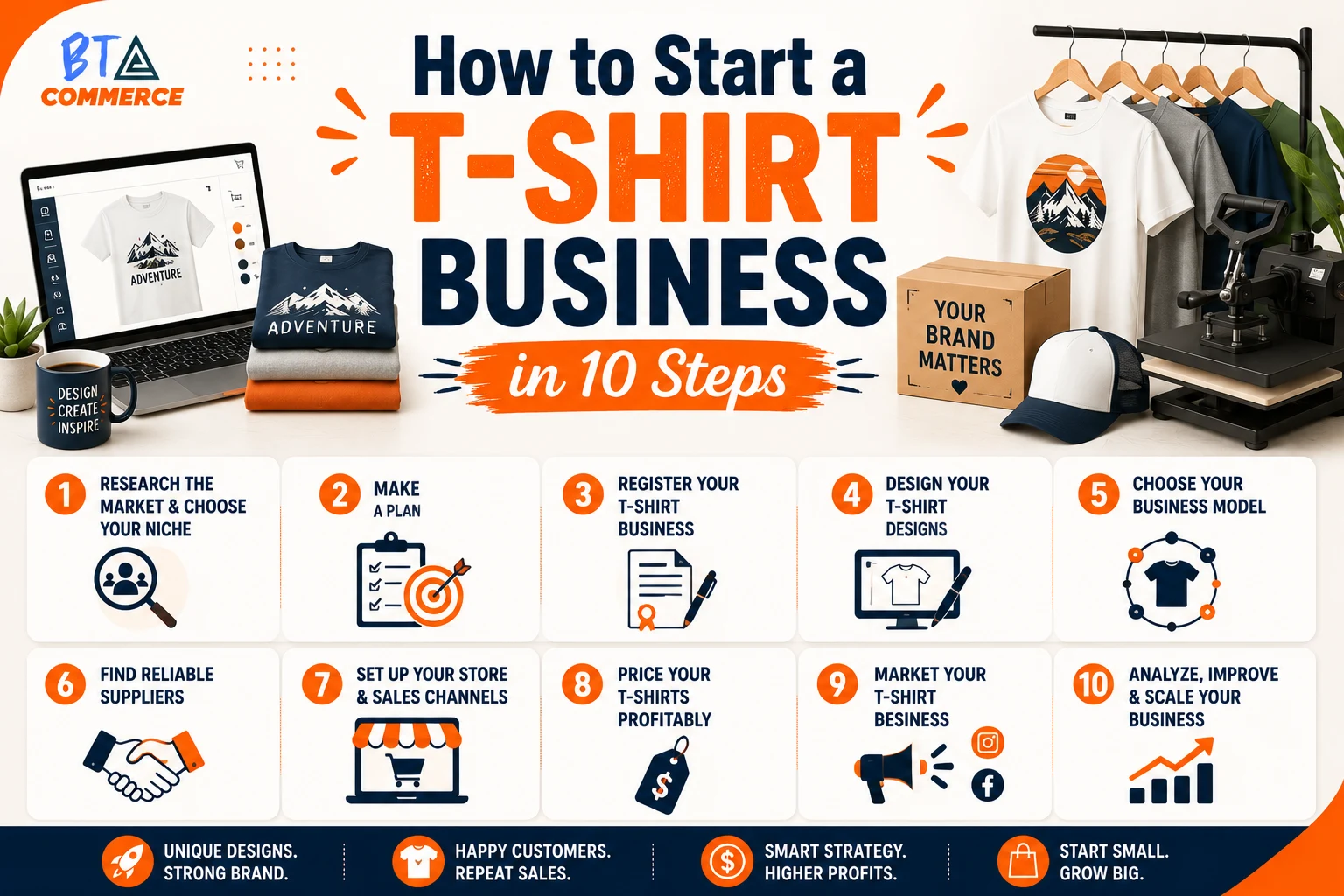
How to Start a T-Shirt Business in 10 Steps
Starting a t-shirt business requires more than creating attractive designs. You need to understand your customers, choose the right market, build a strong business plan, and create a strategy for selling and growing your products. The first steps focus on researching opportunities and preparing a clear direction for your brand.
Step 1. Research the Market and Choose Your Niche
Before creating designs or choosing products, research the market to understand who your customers are and what types of t-shirts they are willing to buy. A successful t-shirt business usually targets a specific niche audience instead of competing in the broad apparel market.
Start by identifying your target customers and their interests. Consider factors such as their lifestyle, hobbies, communities, and purchasing behavior. Creating a customer persona can help you better understand your audience and develop products that match their needs.
For example, instead of targeting all pet owners, you could focus on a smaller niche such as rescue dog owners or specific dog breeds. A focused niche makes it easier to create relevant designs and build stronger customer connections.
Market research should also include competitor analysis. Explore successful t-shirt brands, marketplaces like Etsy and Amazon, and customer reviews to understand:
- Which designs and products perform well.
- How competitors position their products and pricing.
- What customers like or dislike about existing products.
- What opportunities competitors are missing.
You can use platforms such as Reddit, Facebook Groups, and Etsy communities to discover customer interests, common problems, and trending ideas. Tools like Google Trends can also help validate market demand and identify growing topics.
When choosing your niche, focus on creating a unique selling proposition (USP). A specific niche with a clear audience makes it easier to create relevant designs, build a brand identity, and develop effective marketing campaigns.
=> Read more: 20 Clothing Business Ideas That You Can Start Today
Step 2. Make a Plan
A business plan helps turn your t-shirt idea into a structured business. It provides a clear roadmap for your products, production process, marketing strategy, and financial goals while helping you avoid costly mistakes.
Your plan should define the key elements of your business, including:
- Business goals: Define your short-term and long-term objectives, such as sales targets, customer growth, and product expansion.
- Target audience: Identify who you want to sell to and what makes your products valuable to them.
- Product strategy: Decide what types of t-shirts you will sell, including designs, materials, and pricing position.
- Business model: Choose how you will produce and sell your t-shirts, such as print-on-demand, dropshipping, bulk manufacturing, or in-house printing.
- Sales channels: Determine where customers will buy your products, such as your ecommerce store, marketplaces, or social media platforms.
- Marketing approach: Plan how you will attract customers through SEO, social media marketing, influencer marketing, email campaigns, or paid advertising.
- Financial plan: Estimate your startup costs, expected expenses, pricing strategy, profit margins, and revenue goals.
You should also calculate the costs required to launch and operate your business, including website costs, product samples, design tools, production, shipping, and marketing. Understanding your costs early helps you set realistic prices, calculate your profit margin, and build a profitable t-shirt business.
=> Read more: Clothing Business Plan for Boutique and Online Fashion Brands
Step 3. Register Your T-Shirt Business
Before selling t-shirts, you need to establish a legal foundation for your business. Registering your company helps separate your personal and business responsibilities, ensures compliance with local regulations, and makes it easier to manage taxes, payments, and future growth.
Start by choosing a suitable business structure based on your goals, location, and level of liability protection. Common options include:
- Sole Proprietorship: The simplest structure for beginners, but it does not separate personal assets from business liabilities.
- Limited Liability Company (LLC): A popular choice for small businesses because it helps protect personal assets from business debts and legal issues.
You should also register your business name and protect your brand identity. Depending on your location, this may include registering your legal business name, filing a DBA (Doing Business As), or applying for a trademark to protect your brand name and logo.
=> Read more: 800+ T-Shirt Business Name Ideas (Unique, Creative & Brandable)
Other important legal steps may include:
- Obtaining an Employer Identification Number (EIN) if required in your country or region.
- Applying for necessary business licenses and permits.
- Registering for sales tax requirements if you sell taxable products.
- Opening a separate business bank account to keep personal and business finances organized.
The exact requirements depend on where your business operates, so check your local government regulations before launching your t-shirt store.
Step 4. Decide How You’ll Produce T-Shirts
Choosing the right production model affects your startup costs, product quality, profit margins, inventory management, and ability to scale. Consider your budget, business goals, and how much control you want over production before deciding how to make your t-shirts.
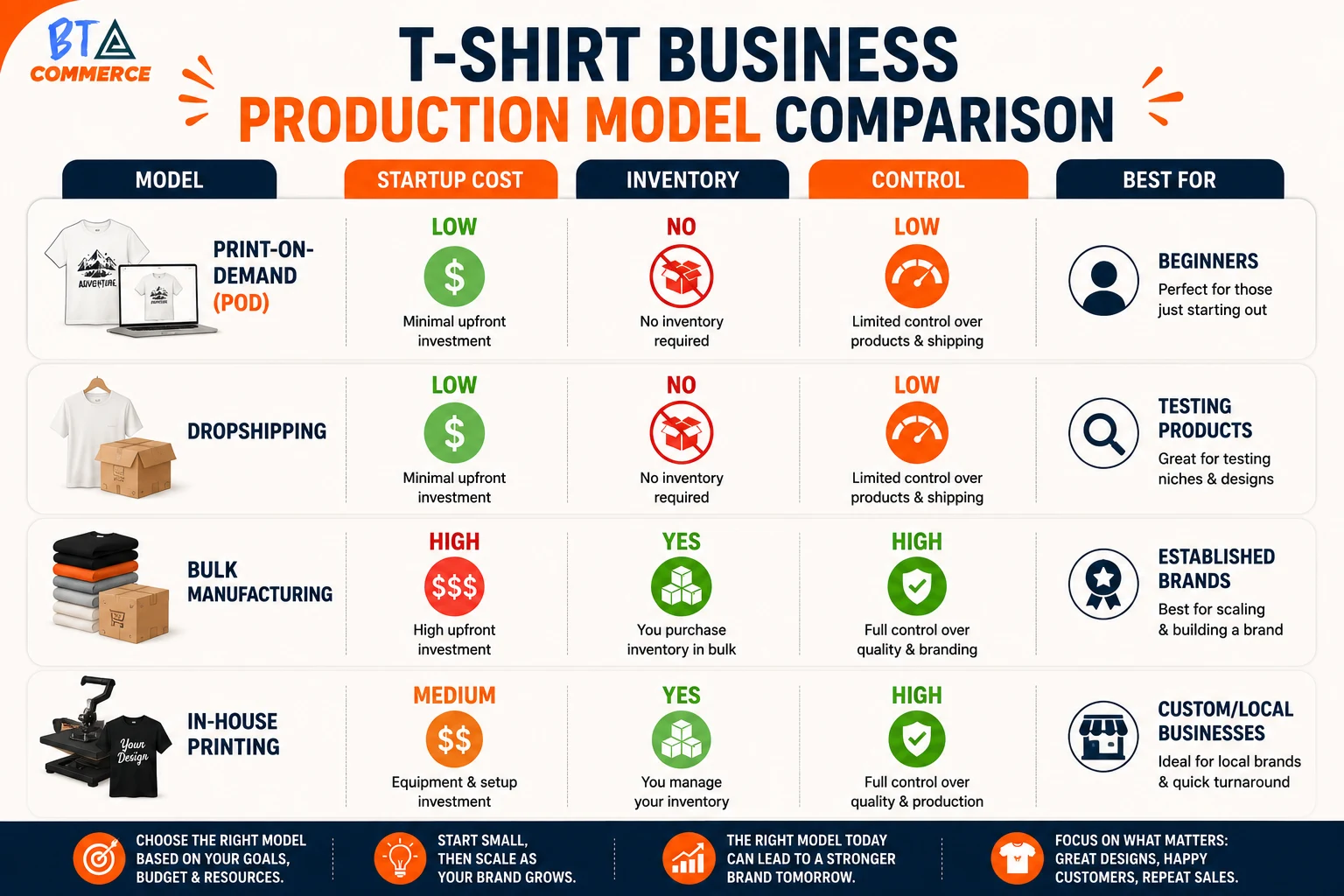
There are several common production models for a t-shirt business:
Print-on-Demand (POD)
Print-on-demand (POD) is one of the easiest ways to start a t-shirt business because you do not need to purchase inventory upfront. When a customer places an order, a POD partner prints the design, packages the product, and ships it directly to the customer.
This model is ideal for beginners who want to test designs and validate market demand with minimal financial risk.
Key benefits include:
- No inventory management.
- Lower startup costs.
- Automated printing, packaging, and fulfillment.
The main drawbacks are lower profit margins and less control over product quality, packaging, and shipping speed.
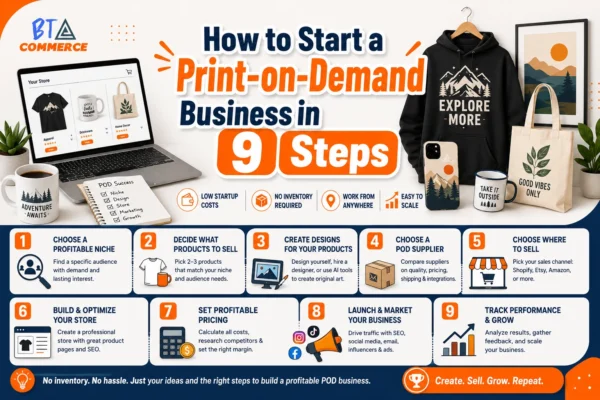
=> Read more: How to Start a Print-on-Demand Business in 9 Steps
Dropshipping
Dropshipping allows you to sell t-shirts without storing inventory. Instead, a third-party supplier handles product fulfillment and shipping after each customer order.
This model requires less upfront investment and reduces operational work, but you have less control over product quality, branding, and customer experience.
=> Read more: How to Start a Dropshipping Business (9-Step Guide for Beginners)
Bulk Manufacturing
Bulk manufacturing involves ordering t-shirts in larger quantities from manufacturers or wholesale suppliers. This approach can reduce the cost per unit and provide more control over materials, printing, packaging, and branding.
However, it requires upfront investment, inventory storage, and better demand forecasting. This model is usually more suitable for businesses that already have proven designs and consistent sales.
In-House Printing
In-house printing allows you to produce t-shirts yourself using equipment such as heat presses, screen printing tools, or direct-to-garment (DTG) printers.
This option provides more control over customization and production quality, making it suitable for small-batch orders, personalized products, or local t-shirt businesses.
However, it requires investment in equipment, materials, workspace, and additional time for printing, packing, and shipping.
Many new t-shirt businesses start with print-on-demand to test their designs and understand customer demand before moving to bulk manufacturing or in-house production. The right production model depends on your budget, business goals, and long-term growth strategy.
Step 5. Create Your T-Shirt Designs
Creating unique designs is one of the most important parts of building a successful t-shirt business. Your designs should match your niche, represent your brand identity, and appeal to the specific audience you want to reach.
Start by developing original concepts based on your target customers’ interests, preferences, and buying behavior. Consider design elements such as:
- Style and messaging: Create designs that communicate a clear idea, emotion, or identity that connects with your audience.
- Design placement: Consider where your artwork will appear, such as the center chest, left chest, sleeves, or back of the t-shirt.
- Colors and readability: Choose colors that work well with your shirt material and ensure your design remains clear when printed.
You do not need advanced design skills to create t-shirt artwork. Beginners can use tools such as Canva or Printful Design Maker to create simple designs, while experienced designers may use professional software like Adobe Illustrator or Affinity Designer for original graphics.
If you are not a designer, you can also hire freelancers through platforms like Fiverr or Upwork to create professional artwork for your brand.
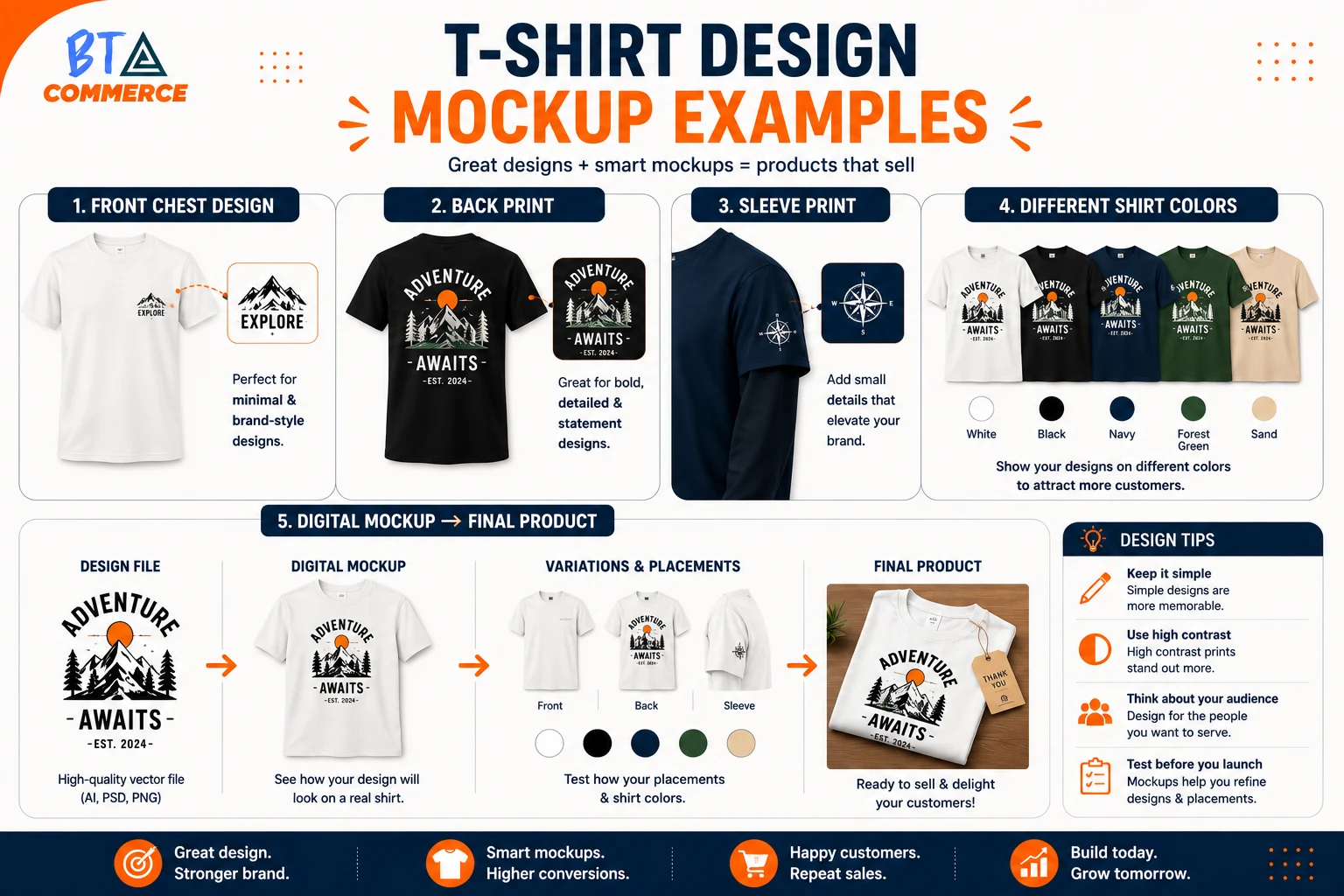
Before printing, prepare your design files according to your supplier’s requirements. High-quality files should generally have:
- A resolution of at least 300 DPI.
- Transparent backgrounds for easier printing.
- Suitable formats such as PNG or vector files like SVG.
Creating mockups is also an important step before launch. Use a mockup generator to preview how your design looks on different t-shirt styles, colors, and sizes. You can then share these designs with potential customers or niche communities to collect feedback and validate demand before investing in production.
Finally, make sure your designs do not violate copyright or licensing rules. Avoid using protected images, logos, characters, or artwork unless you have the proper permission to use them.
Step 6. Choose Your Materials, Printing Method, and Suppliers
The quality of your t-shirts depends on three main factors: the fabric you choose, the printing method you use, and the supplier that produces your products. Selecting the right combination helps you create products that customers enjoy wearing and are willing to recommend.
Choose Your T-Shirt Materials
Different fabrics provide different levels of comfort, durability, and performance:
- Cotton: Soft, breathable, and one of the most popular choices for everyday t-shirts.
- Organic cotton: A sustainable option that appeals to customers looking for eco-friendly products.
- Polyester: Lightweight, durable, and suitable for sportswear or moisture-resistant clothing.
- Blended fabrics: Combine materials such as cotton and polyester to balance comfort, durability, and cost.
Always order samples before selling to customers. Test the fabric quality, sizing accuracy, comfort, print appearance, and how the shirt performs after washing.
Choose a Printing Method
Your printing method should match your design style, order volume, and production model. Common options include:
- Screen printing: Best for large orders with the same design because it offers durable prints and lower costs per unit at higher volumes.
- Direct-to-Garment (DTG): Ideal for detailed, full-color designs and small production runs.
- Direct-to-Film (DTF): Suitable for vibrant designs and works well across different fabric types.
- Heat transfer: A practical option for simple designs, small batches, and customized products.
- Embroidery: Creates a premium look for logos, text, and branded apparel.
- Sublimation: Useful for all-over prints and designs that require full garment coverage.
Choose Reliable Suppliers
Your supplier can directly affect product quality, shipping speed, and customer satisfaction. Evaluate suppliers based on:
- Product quality and consistency.
- Pricing and profit margins.
- Shipping speed and fulfillment options.
- Minimum order requirements.
- Customer reviews and reputation.
For beginners using the print-on-demand model, popular suppliers include Printful, Printify, and Gelato. These platforms handle printing, packaging, and shipping, allowing you to test designs without purchasing inventory upfront.
Before choosing a supplier, always order product samples and check the final results. Testing your products before launch helps prevent quality issues and creates a better customer experience.
Step 7. Calculate Startup Costs and Set Your Prices
Understanding your costs before launching helps you create a realistic budget, avoid underpricing, and build a profitable t-shirt business. Your total investment depends on the production model you choose, such as print-on-demand, bulk manufacturing, or in-house printing.
Start by estimating your main startup expenses, including:
- Website and ecommerce platform: Store subscription fees, domain registration, hosting, and business tools.
- Design expenses: Design software, freelance designers, or branding costs.
- Product samples: Sample orders to test fabric quality, sizing, and print results before selling.
- Production costs: Printing, blank t-shirts, manufacturing, or POD fulfillment fees.
- Inventory and storage: Bulk product purchases and storage costs if you manage your own stock.
- Shipping and packaging: Shipping fees, mailers, labels, and fulfillment expenses.
- Marketing and advertising: Social media promotion, influencer partnerships, SEO, and paid ads.
After calculating your expenses, set your prices based on your total cost per product rather than guessing. Your pricing should cover:
- Production costs and fulfillment fees.
- Platform and payment processing fees.
- Shipping expenses.
- Competitor pricing in your niche.
- Customer expectations and perceived product value.
- Desired profit margin.
A common approach is cost-plus pricing, where you add a target profit margin on top of your total costs. Many apparel businesses aim for around 40%–50% gross margins, but the ideal margin depends on your niche, pricing strategy, and business model.
For example, premium t-shirts with unique designs, high-quality fabrics, or sustainable materials can often support higher prices than basic products. Before finalizing your pricing, compare similar brands on platforms like Etsy and Amazon to understand what customers are willing to pay.
Step 8. Build Your Website and Choose Your Sales Channels
A professional online store gives customers a place to discover your brand, view products, and complete purchases. Your ecommerce website should reflect your brand identity while making the buying process simple and trustworthy.
Start by setting up essential store elements, including:
- Product pages: Add high-quality mockups or product images, sizing information, color options, fabric details, and care instructions.
- Product descriptions: Explain the design concept, materials, fit, and benefits while naturally including relevant keywords.
- Payment methods: Offer trusted payment options such as credit cards, PayPal, Apple Pay, or Shopify Payments to reduce checkout friction.
- Shipping information: Clearly explain processing times, shipping costs, delivery options, and fulfillment details.
- Return policies: Set clear rules for returns and exchanges to build customer confidence.
- Customer support pages: Include contact information, FAQs, and order tracking details to help customers get support quickly.
When choosing your ecommerce platform, consider solutions such as Shopify, Wix, or Squarespace, which provide tools for product management, payments, marketing, and integrations with print-on-demand suppliers.
Beyond your own website, consider selling through multiple channels:
- Your own ecommerce website: Provides full control over branding, customer relationships, and profit margins.
- Online marketplaces: Platforms like Etsy and Amazon can help you reach customers who are already searching for custom apparel.
- Social commerce platforms: Sell directly through channels such as Instagram Shopping, Facebook Shop, or TikTok Shop to connect products with your content.
- Local events and pop-up shops: Test designs, build brand awareness, and connect with customers through markets, festivals, or local partnerships.
Using multiple sales channels can help you reach more customers while reducing dependence on a single platform. Start with the channels that match your target audience and expand as your t-shirt brand grows.
Step 9. Market Your T-Shirt Business
Marketing helps your t-shirt business reach the right customers, build brand awareness, and generate consistent sales. The best strategy combines organic channels, paid advertising, and customer retention methods to attract both new and returning buyers.
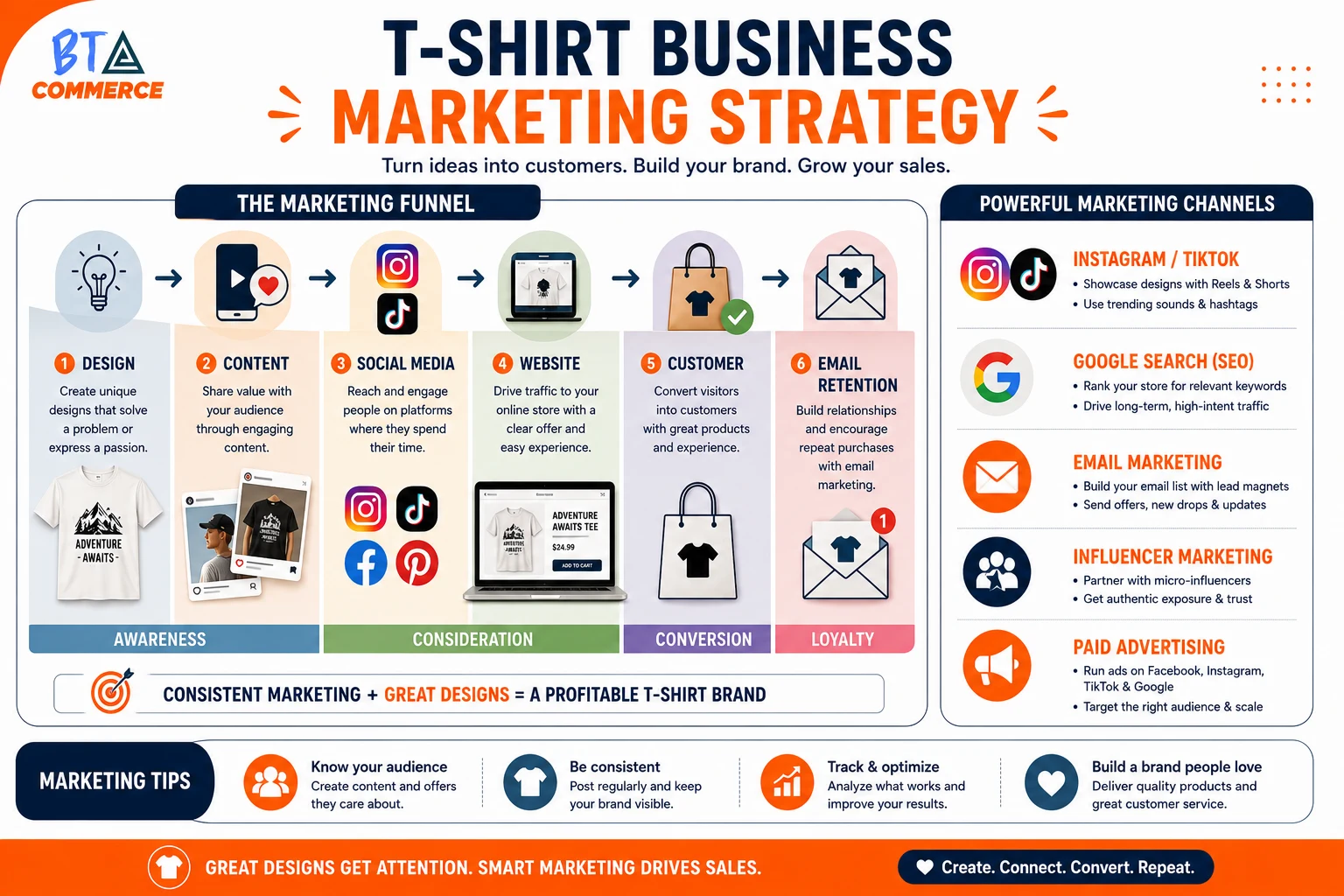
Social Media Marketing
Social media platforms are one of the most effective ways to showcase t-shirt designs and connect with niche communities. Focus on platforms where your target customers spend time, such as Instagram, TikTok, and Facebook.
Effective strategies include:
- Creating short-form videos showing your design process, printing process, packaging, and behind-the-scenes content.
- Sharing customer photos and encouraging user-generated content (UGC) to build social proof.
- Participating in niche communities on platforms like Reddit and Facebook Groups by providing value instead of only promoting products.
Influencer Marketing
Partnering with niche creators and micro-influencers can help you reach highly targeted audiences and build trust through authentic recommendations.
Look for creators who already have an engaged audience related to your niche, such as fitness, pets, hobbies, gaming, or lifestyle communities. Smaller influencers often provide stronger audience connections and can be more affordable for new brands.
SEO and Content Marketing
SEO helps potential customers discover your products through search engines. Optimize your ecommerce store by improving:
- Product titles and descriptions with relevant keywords.
- Product images and mockups for better visibility and conversions.
- Blog content targeting customer questions and niche-related searches.
You can also connect your store with platforms like Google Shopping to help customers find your products when searching for t-shirts online.
Email Marketing
Building an email list allows you to maintain relationships with customers and encourage repeat purchases.
Common strategies include:
- Offering a first-order discount (such as 10%–15%) to encourage signups.
- Sending updates about new designs, product launches, and limited collections.
- Creating exclusive offers for returning customers.
Paid Advertising
Paid ads can help you reach customers who are actively interested in your products. Popular options include:
- Meta Ads (Facebook and Instagram Ads): Target users based on interests, demographics, and online behavior.
- Google Ads: Reach customers searching for specific t-shirt products or niche designs.
- Retargeting campaigns: Re-engage visitors who viewed your products but did not complete a purchase.
Start with a small budget, test different audiences and designs, and scale campaigns that generate profitable sales.
Step 10. Build Your T-Shirt Brand and Scale Your Business
Building a recognizable brand helps your t-shirt business stand out from competitors and create long-term customer loyalty. A strong brand is more than just selling products; it creates a consistent identity that customers remember and trust.
Develop a consistent brand identity through:
- Logo: Create a recognizable symbol that represents your business.
- Brand colors: Use consistent colors across your website, packaging, and marketing materials.
- Visual style: Maintain a unified look across product designs, photos, and social media.
- Brand messaging: Clearly communicate your values, story, and what makes your t-shirts different.
Focus on building customer loyalty through:
- High-quality products that meet customer expectations.
- A smooth shopping experience from browsing to delivery.
- Fast and helpful customer support.
- Consistent communication through email and social media.
As your business grows, scale strategically by:
- Adding new designs: Expand your collection based on customer interests and best-selling products.
- Expanding product categories: Add related products such as hoodies, hats, or accessories.
- Improving production: Move from print-on-demand to bulk production or more efficient fulfillment when demand becomes consistent.
- Optimizing operations: Automate repetitive tasks such as inventory management, order processing, and customer communication.
- Using fulfillment partners: Consider third-party logistics (3PL) services to handle storage and shipping as order volume increases.
Many successful t-shirt brands start with a small number of designs, validate customer demand, and gradually expand. Focusing on products that already perform well helps reduce risk and creates a stronger foundation for long-term growth.
Is Starting a T-Shirt Business Worth It?
Starting a t-shirt business can be a profitable opportunity because the custom apparel market continues to grow and ecommerce makes it easier than ever to reach customers. However, success depends on choosing the right niche, creating unique designs, and building a strong brand rather than simply selling generic shirts.
The biggest advantages of this business model include:
- Low startup costs: You can start with a print-on-demand (POD) model without buying inventory upfront.
- Flexible business models: Choose between POD, dropshipping, bulk manufacturing, or in-house printing based on your budget and goals.
- Easy ecommerce access: Platforms like Shopify, Wix, and marketplaces like Etsy make it easier to launch and sell products.
- Long-term brand potential: Successful businesses can expand into new designs, product categories, and customer communities.
However, a t-shirt business also has challenges. The market is highly competitive, making it important to find a specific niche, create designs that stand out, and invest effectively in marketing. Businesses using POD may also face lower profit margins, while inventory-based models require more upfront investment and risk.
Overall, starting a t-shirt business can be worthwhile for entrepreneurs who focus on a targeted audience, create valuable products, and develop a sustainable marketing strategy.
How Much Does It Cost to Start a T-Shirt Business?
The cost to start a t-shirt business can range from less than $50 to over $10,000, depending on your production model, equipment, inventory, and marketing strategy.
Print-on-Demand (POD): $0–$300
POD is one of the most affordable ways to start a t-shirt business because you can launch without purchasing inventory or managing fulfillment. Your main costs usually include store setup, design tools, samples, and marketing. Your main costs include:
- Ecommerce platform: $0–$299/month depending on the platform and plan.
- Domain name: around $10–$20/year.
- Design tools: $0–$15/month for tools like Canva, or higher costs if hiring designers.
- Product samples: Usually $10–$30 per sample.
- Marketing: Optional starting budget from $50–$500+ per month.
Popular POD suppliers include Printful, Printify, and Gelato.
Inventory-Based Business: $2,000–$5,000+
Buying t-shirts in bulk can reduce production costs but requires more upfront capital. Expenses may include:
- Bulk t-shirt orders: $4–$14 per shirt depending on quantity and quality.
- Storage: $50–$150/month for inventory organization.
- Packaging materials: $1–$3 per order.
- Shipping and fulfillment costs.
- Unsold inventory risk.
This model is better suited for businesses with proven designs and predictable demand.
In-House Printing: $500–$2,000+
Printing your own shirts provides more control over quality and customization but requires equipment investment.
Typical costs include:
- Heat press machine: $150–$500.
- Vinyl cutter or craft cutter: around $200+.
- Blank shirts: $3–$6 per shirt.
- DTF transfers: $1–$3 per design.
- Workspace and printing supplies.
Additional expenses to consider:
- Business registration and licenses.
- Branding and logo design.
- Ecommerce apps and software.
- Photography and product mockups.
- Advertising campaigns.
Before setting your prices, calculate all costs, including production, shipping, platform fees, and marketing. Many t-shirt brands aim for around 40%–50% profit margins, so your pricing strategy should leave enough room for sustainable growth.
How To Start a T-Shirt Business FAQs
How do I start a T-shirt business from home?
You can start a t-shirt business from home by choosing a low-risk model such as print-on-demand (POD) or small-scale printing. The basic process includes choosing a niche, creating designs, setting up an online store, and working with suppliers for production and fulfillment.
POD platforms like Printful, Printify, and Gelato allow beginners to sell custom t-shirts without inventory or printing equipment. If you want more control, you can invest in home printing equipment such as a heat press or DTF setup.
Can I start a T-shirt business with no money?
Yes, you can start a t-shirt business with almost no upfront investment by using print-on-demand platforms, free design tools, and organic marketing channels. However, building a profitable brand still requires time, effort, and some investment in areas such as product samples, branding, and customer acquisition.
Do I need a business license to sell T-shirts online?
Business requirements depend on your location and business structure. Many t-shirt sellers need to register their business, follow local licensing rules, and comply with sales tax requirements. In the United States, some businesses may also need an Employer Identification Number (EIN). Check your local regulations before launching your store.
What is the cheapest way to start a T-shirt business?
The cheapest way to start a t-shirt business is usually through print-on-demand (POD) because it removes the need for inventory, storage, and printing equipment.
However, while POD reduces upfront costs, it usually provides lower profit margins compared with bulk manufacturing or in-house printing. While POD reduces financial risk, it usually offers lower profit margins than bulk production.
How do I start a T-shirt printing business?
Starting a t-shirt printing business requires choosing a production method, sourcing blank apparel, and building a reliable workflow.
Beginners can start with low-cost options such as heat transfer or DTF, while larger businesses often use screen printing for bulk orders. Before investing in equipment, test demand, calculate production costs, and ensure your process can maintain consistent quality.
How profitable is a T-shirt business?
A t-shirt business can be profitable, but success depends on niche selection, product quality, pricing, and marketing. Many apparel businesses aim for around 40%–50% gross profit margins, although actual profits vary by business model.
POD businesses typically have lower margins but lower risk, while bulk manufacturing or in-house printing can improve margins with higher investment. A focused niche and strong brand identity are often more important than simply selling more designs.
Recommended Reading