Starting a dropshipping business is one of the most accessible ways to enter ecommerce without managing inventory or handling product fulfillment yourself. By partnering with suppliers, you can focus on building your store, attracting customers, and growing your brand.
This guide explains how to start a dropshipping business step by step, from choosing a profitable niche and finding reliable suppliers to launching your online store and marketing your products effectively.
What is dropshipping and how does it work?
Dropshipping is an ecommerce fulfillment model where you sell products without keeping inventory in stock. Instead, when a customer places an order, a third-party supplier fulfills and ships the product directly to the buyer.
The process typically works as follows:
- You create an online store and list products from suppliers.
- A customer places an order on your website.
- You forward the order to the supplier and pay the wholesale price.
- The supplier ships the product directly to the customer.
- You keep the difference between the retail price and wholesale cost as profit.
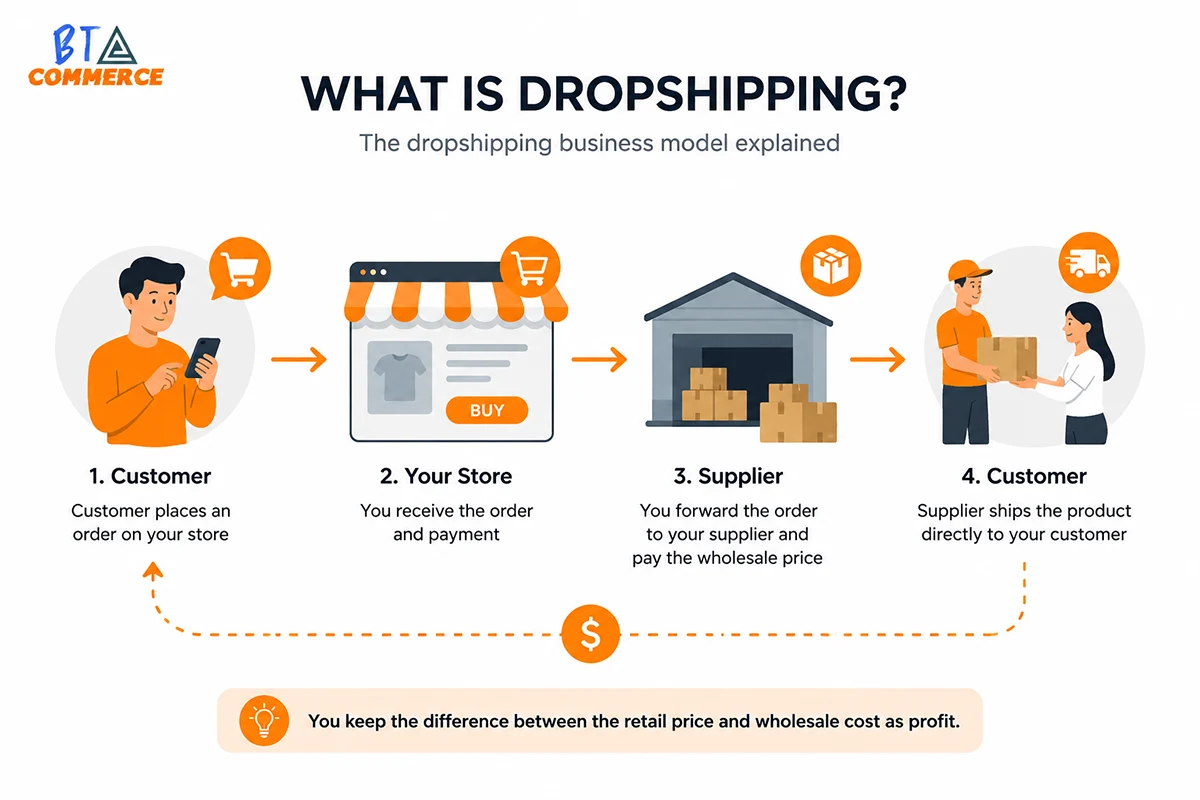
This model is popular because it requires less upfront investment than traditional retail. You do not need to purchase inventory in advance, manage a warehouse, or handle shipping logistics yourself.
The biggest advantage of dropshipping is its low startup cost and flexibility, making it easier to launch an ecommerce business without investing heavily in inventory. However, the trade-off is that profit margins are often lower, and your success depends heavily on supplier reliability, product quality, and shipping performance. To build a profitable dropshipping business, you’ll need the right products, dependable suppliers, and an effective strategy for attracting customers.
How to Start a Dropshipping Business in 9 Easy Steps
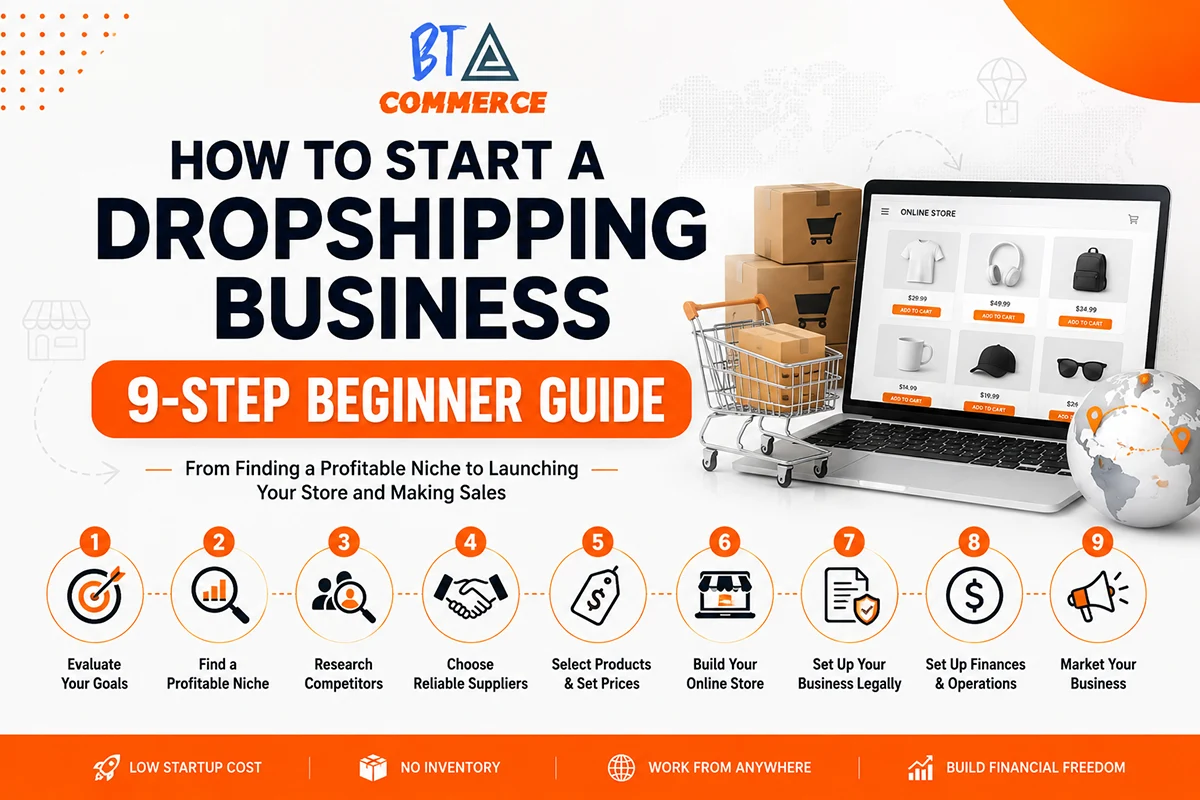
1. Evaluate whether dropshipping fits your goals
Dropshipping eliminates inventory management, but it requires consistent effort in marketing, customer service, and store optimization. Before committing to the business model, consider the following factors:
- Profit margins can be tight. To leave room for advertising and operating costs, many dropshippers target products that generate at least $25 in gross profit per sale or fall within the $30–$80 price range for impulse purchases.
- Shipping times may be longer than expected. Many suppliers ship internationally, which can result in delivery times of one to three weeks. Clear communication is essential to avoid customer complaints and refund requests.
- You still need startup capital. While you don’t need to buy inventory upfront, you’ll need a budget for website hosting, ecommerce tools, product testing, and marketing campaigns.
- Success depends heavily on marketing. Unlike traditional retail, having a good product is rarely enough. Your ability to attract traffic and convert visitors into customers will have a direct impact on profitability.
If you’re comfortable investing time and money into customer acquisition and testing, dropshipping can be an effective way to enter ecommerce with lower upfront risk.
2. Find a profitable dropshipping niche
Choosing the right niche is one of the most important decisions you’ll make. A profitable niche should have proven demand, manageable competition, and products that customers are willing to pay a premium for. Instead of targeting broad markets like electronics or home goods, focus on a specific audience or problem you can serve more effectively.
Finding a niche with keyword research
Keyword research helps validate whether people are actively searching for products in a niche before you invest time and money into building a store.
- Start with specific seed keywords. For example, “orthopedic dog bed” provides more insight into customer demand than a broad term like “pet supplies.”
- Use tools such as Google Trends and Google Keyword Planner to evaluate search volume and determine whether interest is growing, stable, or seasonal.
- Analyze search intent. Keywords that indicate a problem or purchase intent often have stronger commercial value than informational searches.
- Research competitors using tools like Ahrefs or Semrush to identify the keywords they rank for and uncover opportunities they may be overlooking.
Finding a niche with product research
Keyword demand alone isn’t enough—you also need products that people are actively buying.
- Look for products that solve a specific problem or offer a clear benefit. These are typically easier to market than generic items.
- Prioritize products with a strong visual appeal or “wow factor” that can be demonstrated through short-form video content and social media ads.
- Browse platforms such as TikTok, Instagram, and the Meta Ad Library to identify products generating high engagement, shares, and comments.
- Explore supplier marketplaces like AliExpress or dropshipping platforms such as Spocket to find products with strong order volume and positive customer feedback.
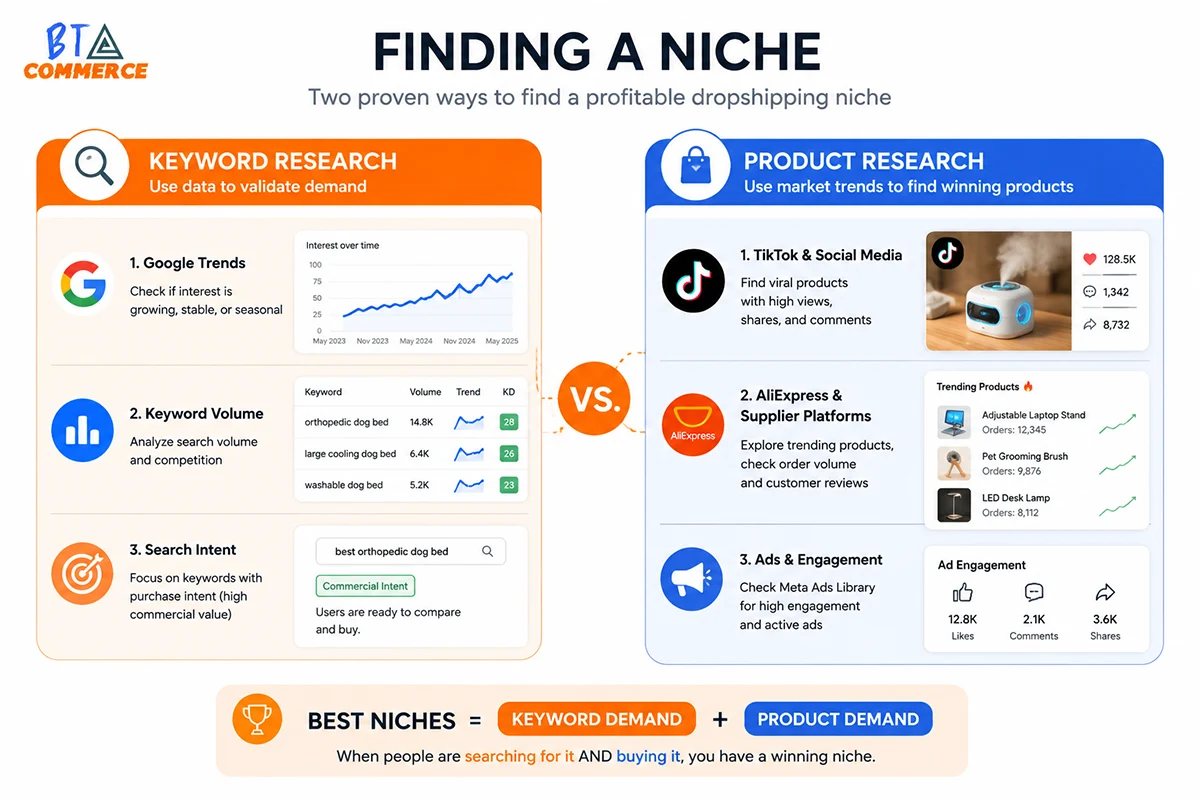
The best niches are usually validated from both angles: people are searching for them, and customers are already buying related products. Combining keyword research with product research helps reduce guesswork and increases your chances of finding a niche with long-term potential.
=> Read more:
- 15 Dropshipping Business Ideas with Strong Profit Potential
- 450+ Modern & Catchy Dropshipping Business Name Ideas
3. Research competitors
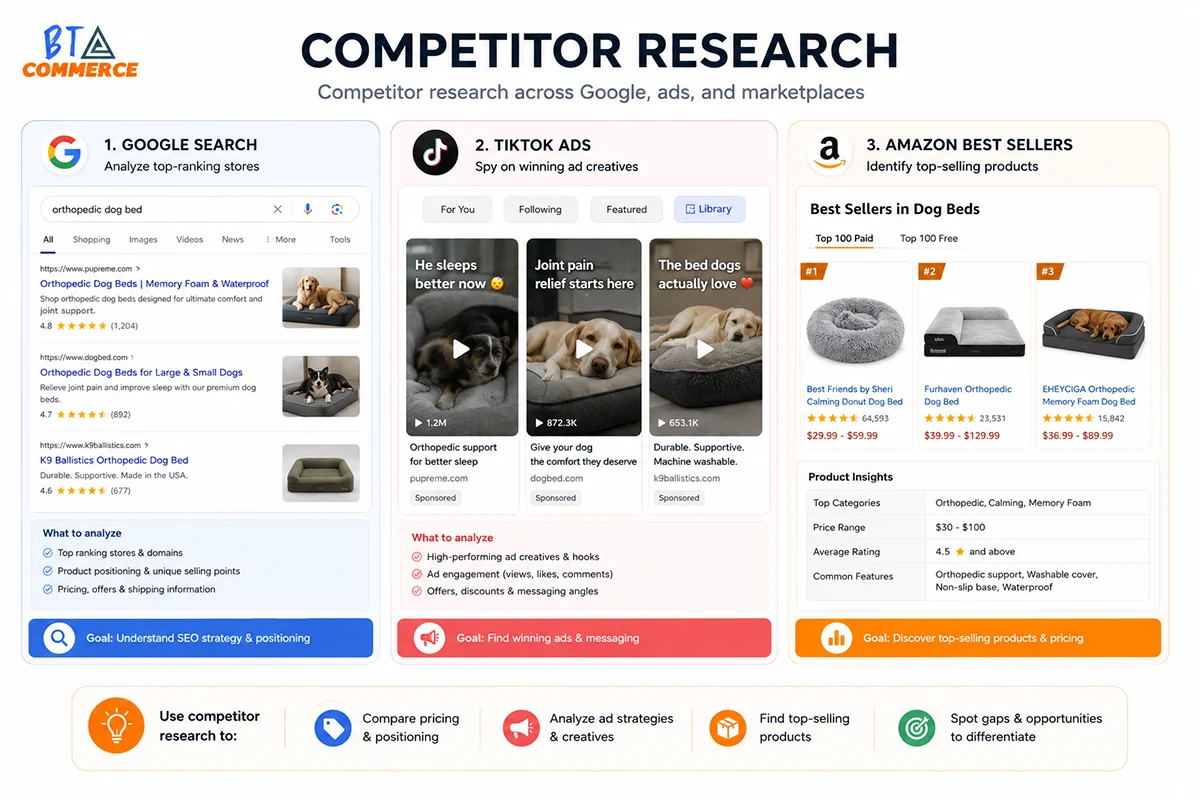
Once you’ve identified a potential niche, study the businesses already serving that market. The goal isn’t to copy competitors—it’s to understand customer expectations, pricing standards, and opportunities to differentiate your store.
Google search
Search your target keywords and analyze the stores that consistently appear on the first page.
For example, if you’ve chosen the orthopedic dog bed niche, search terms such as “orthopedic dog bed,” “memory foam dog bed,” and “large orthopedic dog bed.” Review the stores ranking at the top and compare their pricing, product positioning, and customer offers.
- Compare product pricing to understand the typical price range customers are willing to pay.
- Analyze product descriptions and landing pages to see how competitors communicate benefits.
- Review customer ratings and feedback to identify recurring complaints or unmet needs.
- Look for differentiation opportunities, such as better sizing guides, faster shipping, or stronger guarantees.
Competitor research tools
Research tools can help you understand how competitors attract traffic and generate sales.
For example, if a leading competitor ranks for dozens of keywords related to orthopedic dog beds, tools like Ahrefs or Semrush can reveal which pages generate the most organic traffic and which search terms drive visitors to their store.
- Identify competitors’ highest-performing pages and products.
- Analyze the keywords they rank for in search engines.
- Monitor their paid advertising activity and landing pages.
- Look for gaps in their content or product selection that you can target.
Social media platforms
Social media reveals how competitors market products and engage their audience.
For example, if a competitor’s TikTok video demonstrating a dog bed’s pressure-relief benefits has hundreds of thousands of views, that’s a strong signal that the product resonates with customers.
- Study the content formats generating the most engagement.
- Analyze how competitors use influencers, product demos, and customer testimonials.
- Review comments to uncover customer questions and objections.
- Identify recurring themes that can inspire your own marketing strategy.
Online marketplaces
Marketplaces provide useful benchmarks for demand, pricing, and customer expectations.
For example, if the top orthopedic dog beds on Amazon have thousands of reviews and consistently rank among best sellers, that’s a strong indication of sustained demand.
- Compare pricing across Amazon, eBay, and other marketplaces.
- Review customer feedback to identify common product strengths and weaknesses.
- Analyze how top sellers structure their listings, images, and offers.
- Look for opportunities to improve through branding, bundles, warranties, or customer support.
By the end of this step, you should have a clear understanding of how competitors position their products, what customers value most, and where your store can stand out.
4. Choose reliable suppliers
Your supplier directly affects product quality, shipping speed, customer satisfaction, and profit margins. A poor supplier can lead to delayed deliveries, refund requests, and negative reviews, while a reliable one helps you build trust and repeat business.
Most dropshippers source products through marketplaces like AliExpress and CJ Dropshipping, dedicated dropshipping platforms such as Zendrop and Spocket, or private sourcing agents for more advanced operations.
Before choosing a supplier, evaluate:
- Shipping speed: If you’re targeting the US, UK, or Europe, prioritize suppliers that can consistently deliver within 5–10 days.
- Order processing time: Reliable suppliers typically process orders within 24–48 hours.
- Inventory reliability: Frequent stock shortages can lead to canceled orders and lost sales.
- Returns and refunds: Understand how damaged items, lost packages, and customer returns are handled.
- Communication: Test response times before partnering. Slow or unclear communication often becomes a bigger problem as order volume grows.
For example, if two suppliers offer the same orthopedic dog bed at a similar price, but one ships from a US warehouse in 7 days while the other takes 20+ days, the faster supplier will usually create a better customer experience.
Before launching, order a sample product yourself to verify shipping speed, packaging quality, and product accuracy. Also review supplier ratings and feedback history, prioritizing sellers with a strong track record and consistently positive reviews.
5. Select products and set prices
Not every product in your supplier’s catalog deserves a place in your store. Focus on products with proven demand, clear customer value, and enough margin to support advertising and operating costs.
When evaluating products, consider:
- Solve a specific problem: Products that address a pain point are often easier to market than generic alternatives. For example, an orthopedic dog bed solves joint discomfort, while a standard dog bed mainly competes on price.
- Offer healthy margins: Many dropshippers target products that can be sold for 2.5–3 times the supplier cost, creating room for advertising and other expenses.
- Have strong perceived value: Products with unique features, before-and-after results, or visual demonstrations often convert better in ads and social media content.
- Support complementary purchases: Related products can be bundled together to increase average order value. For example, a pet travel store could sell portable water bottles, collapsible bowls, and travel seat covers as a package.
Once you’ve selected your products, develop a pricing strategy that balances profitability with market expectations.
- Research competitor pricing to understand the acceptable price range.
- Use psychological pricing, such as $49.99 instead of $50.
- Consider bundle pricing to increase order value without significantly increasing customer acquisition costs.
- Avoid competing solely on price, especially if your store offers better branding, packaging, or customer support.
For example, if a product costs $15 including shipping, pricing it at $39.99–$49.99 may leave enough margin to cover advertising costs while remaining competitive in the market.
6. Build a dropshipping website or online store
Your website is where customers discover products, evaluate your brand, and decide whether to buy. A well-designed store can improve trust and conversions, while a poor user experience can drive potential customers away.
To build a professional dropshipping store:
- Choose an ecommerce platform that fits your budget and technical requirements. Popular options include Shopify, WooCommerce, and Wix.
- Register a custom domain name that is short, memorable, and easy to spell.
- Use a clean, mobile-friendly theme that makes products easy to browse and purchase.
- Create essential pages such as About Us, Contact Us, Shipping Policy, Returns Policy, and Privacy Policy to build credibility.
- Connect dropshipping tools such as DSers, AutoDS, Spocket, or Printful to automate product imports, inventory updates, and order fulfillment.
- Set up secure payment methods, such as Stripe or PayPal, and offer multiple payment options whenever possible.
Product pages are often the biggest factor influencing conversions. Avoid copying supplier descriptions and instead focus on helping customers understand why the product is valuable.
- Use high-quality images and videos.
- Highlight benefits, use cases, and key selling points.
- Add customer reviews and shipping information to reduce purchase hesitation.
- Include FAQs to answer common questions before customers reach checkout.
For example, instead of listing only the specifications of an orthopedic dog bed, explain how it can improve comfort and support for older dogs or pets with joint issues. This makes the product more relatable and persuasive to potential buyers.
Before launching, test the entire shopping experience—from browsing products to completing checkout—to ensure customers can place orders without friction.
7. Set up your business legally
As your dropshipping business grows, operating under a formal business structure can help protect your assets, simplify accounting, and improve credibility with suppliers and payment providers.
The three most common business structures are:
- Sole proprietorship: The simplest option for beginners. It requires minimal paperwork and allows you to report business income on your personal tax return. However, there is no legal separation between you and the business, meaning your personal assets may be at risk if the business faces debts or legal claims.
- Limited liability company (LLC): An LLC creates a legal separation between personal and business finances, providing liability protection while maintaining relatively simple tax and administrative requirements. For many dropshipping businesses, it offers a practical balance between protection and flexibility.
- Corporation: Corporations provide the strongest liability protection and can make it easier to attract investors or raise capital. However, they involve more paperwork, higher compliance requirements, and potentially less favorable tax treatment for smaller businesses.
For example, someone testing a new niche with a limited budget may start as a sole proprietorship, while a store generating consistent revenue may choose an LLC to better protect personal assets and establish a more professional business presence.
Business registration, tax obligations, and licensing requirements vary by country and state. Depending on your location, you may need to obtain business registrations, tax IDs, or licenses before operating. For example, businesses in the United States often apply for an Employer Identification Number (EIN) to file taxes, open business bank accounts, and work with certain suppliers. Consider consulting a qualified accountant or legal professional to ensure your business complies with local regulations.
8. Set up finances and business operations
Strong financial management is essential for running a sustainable dropshipping business. Separating business finances, tracking cash flow, and staying compliant with local regulations will make it easier to manage growth and avoid costly mistakes.
Start with these core areas:
- Open a business bank account: Keeping business and personal finances separate simplifies bookkeeping, improves financial visibility, and can provide additional legal protection depending on your business structure.
- Use dedicated payment methods: A business credit card or dedicated payment account helps you track expenses such as advertising, software subscriptions, domain renewals, and supplier payments.
- Set up secure payment processing: Payment gateways such as Stripe and PayPal allow customers to check out securely while helping you manage transactions and payouts efficiently.
- Track costs and cash flow carefully: Your profit margin should account for product costs, shipping fees, payment processing fees, platform subscriptions, and advertising expenses. For example, a product that generates a $20 gross margin may become unprofitable if customer acquisition costs average $25 per sale.
- Understand tax and licensing requirements: Depending on your location, you may need business licenses, sales tax registrations, or other compliance documentation before operating legally.
One common challenge in dropshipping is cash flow management. Customers pay you first, but suppliers typically require payment before fulfilling orders. Maintaining a financial buffer can help prevent fulfillment delays and keep operations running smoothly as order volume grows.
9. Market your dropshipping business
Even the best products won’t generate sales if customers never discover them. Successful dropshipping businesses typically combine long-term organic marketing with paid acquisition channels to create a consistent flow of traffic and sales.
Focus on these key marketing strategies:
- SEO: Optimize product pages, category pages, and blog content around keywords your target audience is searching for. For example, a store selling orthopedic dog beds could target searches such as “best orthopedic dog bed for senior dogs” instead of competing for broad keywords like “dog bed.”
- Paid advertising: Platforms such as Google, Facebook, Instagram, and TikTok can help you reach customers quickly. Many dropshippers use paid ads to test products, validate demand, and identify winning products before scaling their budgets.
- Influencer marketing: Partnering with niche influencers can provide social proof and expose your products to highly relevant audiences. Micro-influencers often deliver better engagement rates and lower costs than larger creators.
- Content marketing: Educational content, buying guides, product comparisons, and short-form videos can attract potential customers while building trust in your brand. This strategy also supports long-term SEO growth.
- Email marketing: Email remains one of the highest-ROI marketing channels for ecommerce businesses. Automated campaigns such as welcome emails, abandoned cart reminders, and post-purchase follow-ups can help recover lost sales and encourage repeat purchases.
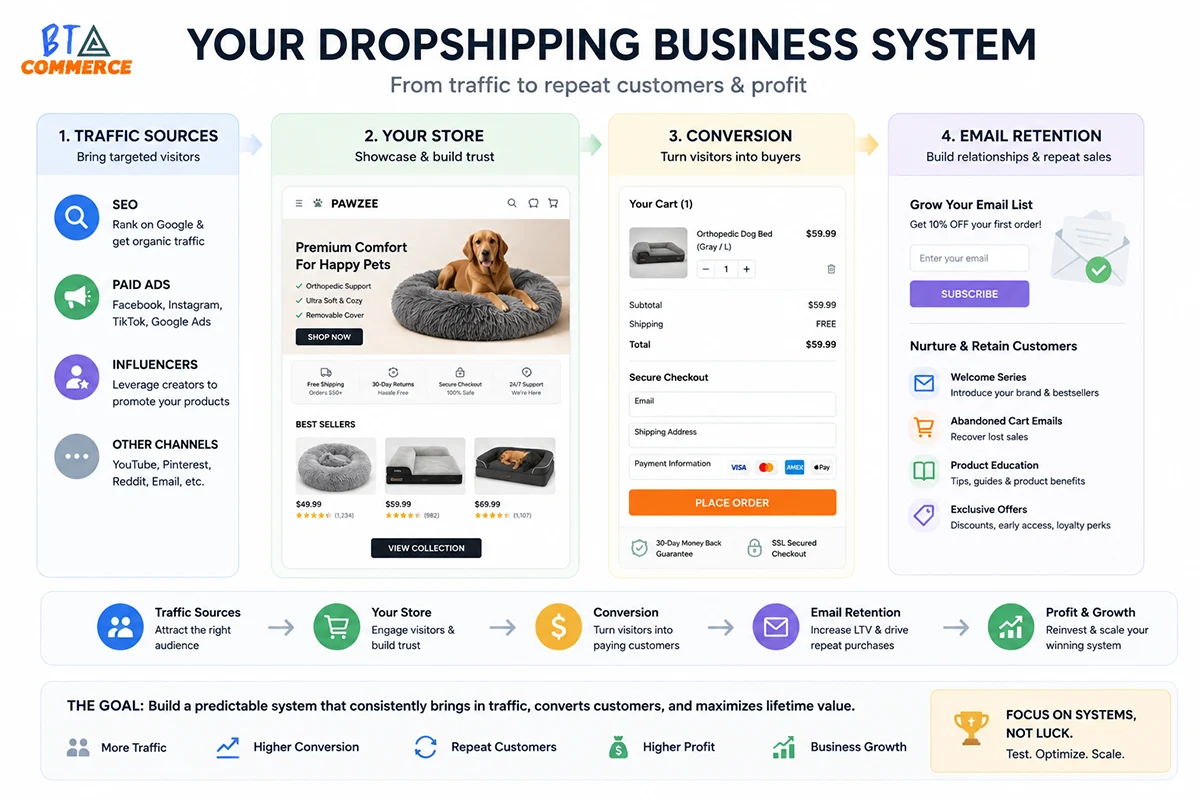
For example, a pet-focused dropshipping store might use TikTok videos to generate awareness, Google Search to capture purchase intent, and email campaigns to turn first-time buyers into repeat customers. Combining multiple channels often produces more sustainable growth than relying on a single source of traffic.
Read more:
- How to Start a Business in 10 Practical Steps to Succeed
- How to Start an Online Business (8-Step Beginner Guide)
- How to Start a Jewelry Business (Step-by-Step Guide)
- How to Start a Clothing Brand: Step-by-Step Guide for Beginners
Common dropshipping mistakes beginners should avoid
Many dropshipping stores fail not because the business model doesn’t work, but because common mistakes erode profitability and customer trust. Avoiding these issues early can save both time and money as your business grows.
- Choosing products without validating demand: Many beginners select products based on personal preference rather than market data. Before launching a product, verify demand through keyword research, competitor analysis, social media trends, and supplier order history.
- Relying on a single supplier: Stock shortages, shipping delays, or quality issues can quickly disrupt your business. Whenever possible, identify backup suppliers for your best-selling products to reduce operational risk.
- Ignoring shipping times and customer expectations: Long delivery windows are one of the biggest causes of refund requests and negative reviews. Be transparent about shipping estimates and work with suppliers that offer reliable fulfillment whenever possible.
- Using generic supplier content: Copying product titles, descriptions, and images from suppliers makes it difficult to stand out and can hurt SEO performance. Create unique product pages that clearly explain benefits, answer common questions, and build trust.
- Neglecting SEO and organic traffic: Many new store owners rely entirely on paid advertising. While ads can generate sales quickly, SEO helps build sustainable traffic over time and reduces customer acquisition costs.
- Failing to track performance data: Decisions should be based on data, not assumptions. Monitor metrics such as conversion rate, advertising costs, profit margins, top-selling products, and customer acquisition channels to identify what’s working and what needs improvement.
- Trying to sell too many products at once: A focused niche store is often easier to brand, market, and optimize than a general store with hundreds of unrelated products. Start with a small, carefully selected product catalog and expand based on performance.
- Providing poor customer support: Even though suppliers handle fulfillment, customers still see your store as responsible for the entire buying experience. Fast responses, clear policies, and efficient handling of refunds or shipping issues can significantly improve customer retention and brand reputation.
Successful dropshipping businesses treat these areas as ongoing priorities. Strong supplier relationships, data-driven decisions, consistent marketing, and a positive customer experience often make the difference between a store that struggles and one that scales.
How to start a dropshipping business FAQs
How do I start dropshipping with no experience?
Start by choosing a niche, finding reliable suppliers, and creating an online store using a beginner-friendly ecommerce platform. Focus on learning product research, marketing, and customer service as you grow.
How much money do I need to start a dropshipping business?
Many dropshipping businesses can be launched with $100–$500. Common startup costs include a domain name, ecommerce platform subscription, dropshipping apps, and an initial budget for product testing or advertising.
Is dropshipping easy for beginners?
Dropshipping is easier to start than traditional retail because you don’t need to manage inventory. However, success still requires product research, marketing skills, customer support, and ongoing testing.
How do dropshipping businesses make money?
Dropshipping businesses earn money through product markups. The profit is the difference between the retail price charged to customers and the supplier cost, minus advertising, transaction, and operating expenses.
How do I start dropshipping on Shopify?
Create a Shopify store, choose a theme, connect a dropshipping app such as DSers or Spocket, import products, customize your store, and begin marketing to attract customers.
Can I create a dropshipping website without coding?
Yes. Platforms like Shopify, WooCommerce, and Wix provide user-friendly tools that allow you to build and manage a dropshipping website without coding knowledge.
Recommended Reading