Starting a beverage business involves much more than creating a great-tasting drink. From validating your idea and developing a beverage formula to finding production partners, meeting food regulations, and building distribution channels, every step plays a role in turning your concept into a successful brand.
In this guide, BTA Commerce explains how to start a beverage business step by step, covering product development, manufacturing, branding, and launch strategies to help you build a sustainable beverage company with confidence.
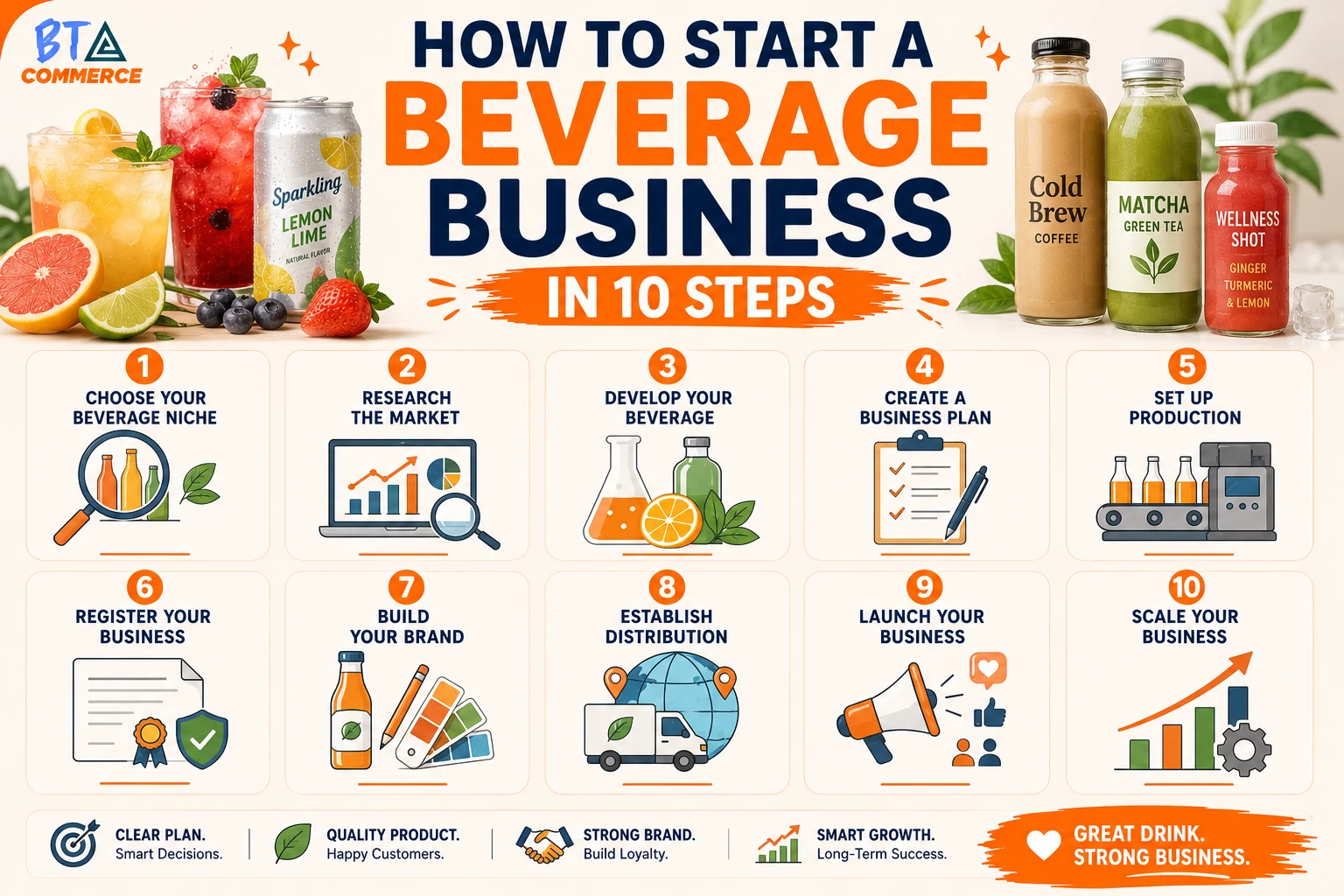
1. Choose Your Beverage Niche
Choosing the right beverage niche is the first step in building a successful beverage business. Instead of entering the broad beverage market, focus on a specific category that aligns with your experience, resources, and long-term goals.
Popular beverage niches include:
- Functional beverages: Drinks designed to provide health or wellness benefits, such as energy drinks, probiotic beverages, electrolyte drinks, and mushroom-based beverages. Examples include brands like Red Bull and Liquid I.V.
- Plant-based beverages: Dairy alternatives made from ingredients such as oats, almonds, soy, and coconut. This category includes products like oat milk, almond milk, and other non-dairy alternatives.
- Craft sodas and sparkling beverages: Premium carbonated drinks featuring unique flavors, natural ingredients, lower sugar content, or functional benefits. Examples include better-for-you soda brands like Poppi and OLIPOP.
- Wellness shots: Small, concentrated beverages made with functional ingredients such as ginger, turmeric, or apple cider vinegar. Brands like Suja Organic have helped grow this category.
- Ready-to-drink (RTD) beverages: Convenient packaged drinks, including bottled coffee, tea, cocktails, mocktails, and functional beverages. Examples include brands like Celsius in the functional energy drink market.
- Low- or no-alcohol beverages: Alcohol-free alternatives, including non-alcoholic beers, botanical drinks, and zero-proof cocktails designed for consumers seeking healthier lifestyle choices.
When choosing your niche, consider factors such as startup budget, access to ingredients and suppliers, production options, market potential, and your ability to build a differentiated brand. Selecting the right category will give your beverage business a clear direction before moving into market research.
Read more:
- 360+ Drink Business Name Ideas You’ll Want to Steal
- How to Start a Business in 10 Practical Steps to Succeed
- How to Start a Food Business Step-by-Step Guide
2. Research the Market
After choosing your beverage niche, validate your business idea through market research. This step helps you understand demand, identify your ideal customers, analyze competitors, and find opportunities to position your beverage effectively.
Focus your research on the following areas:
- Market size and growth potential: Evaluate the size of your target market, industry growth trends, and whether your chosen beverage category has enough demand to support long-term business growth.
- Market demand: Analyze consumer trends, industry reports, and tools like Google Trends to identify growing categories, such as functional beverages, sugar-free drinks, ready-to-drink (RTD) beverages, plant-based drinks, and sustainable packaging.
- Target audience: Define your ideal customers, including their demographics, preferences, lifestyles, purchasing behaviors, and the specific needs your beverage aims to address.
- Competitor analysis: Study existing beverage brands to understand their products, pricing, ingredients, packaging, branding, distribution channels, and market positioning.
- Market opportunities: Identify underserved customer groups, unmet needs, or emerging trends where your beverage can offer a stronger alternative to existing products.
- Unique selling proposition (USP): Based on your research, determine what makes your beverage different, such as unique ingredients, functional benefits, innovative flavors, sustainable practices, or a distinctive brand story.
Conducting thorough market research helps you confirm that your beverage idea has real market potential before investing in product development, manufacturing, and branding.
3. Develop Your Beverage
With your market research complete, the next step is turning your beverage concept into a commercial product. Your beverage should not only taste great but also be safe, shelf-stable, and suitable for large-scale production.
Focus on the following tasks:
- Create your beverage formula: Work with a beverage formulator or food scientist to develop a recipe with the right balance of flavor, sweetness, acidity, texture, nutritional content, and functional ingredients. Your formula should also be shelf-stable and scalable for commercial production.
- Choose quality ingredients: Select high-quality flavors, sweeteners, acids, preservatives, vitamins, minerals, and other ingredients that support product quality, food safety, shelf life, and consistent production.
- Develop a prototype: Produce small pilot batches to evaluate your beverage’s taste, appearance, consistency, and manufacturing feasibility before committing to full-scale production.
- Test and refine your product: Conduct blind taste tests, focus groups, customer surveys, pilot production runs, and shelf stability testing to evaluate product quality, gather feedback, and improve your beverage until it consistently meets your taste, safety, and quality standards.
A thoroughly tested beverage is easier to manufacture consistently, delivers a better customer experience, and gives your business a stronger foundation for a successful launch.
4. Create a Business Plan
A well-structured business plan helps you evaluate your startup’s feasibility, estimate funding requirements, and prepare for long-term growth. It also serves as an essential document when applying for loans or pitching your beverage business to investors.
Focus on the following areas:
- Define your business model: Decide how your business will generate revenue, whether through direct-to-consumer (DTC) sales, wholesale, retail distribution, subscriptions, or a combination of sales channels.
- Estimate startup costs and funding needs: Calculate the costs of product development, ingredients, manufacturing, packaging, equipment, licensing, marketing, inventory, and working capital to determine your total startup budget. Consider potential funding options, such as personal savings, business loans, or investors, based on your financial situation and growth plans.
- Set your pricing strategy: Price your beverage based on production costs, target profit margins, competitor pricing, and your target market while maintaining a competitive position.
- Create financial projections: Prepare realistic revenue forecasts, operating expenses, cash flow projections, and a break-even analysis to evaluate your business’s financial performance over the first few years.
A comprehensive business plan provides a clear roadmap for launching your beverage business and making informed decisions as your company grows.
=> Read more: How to Write a Business Plan for Startups & Small Businesses
5. Set Up Production
With your business plan in place, the next step is establishing a production process that consistently delivers safe, high-quality beverages. Whether you manufacture in-house or work with a co-packer, your production setup should support product consistency, food safety, and future growth.
Focus on the following tasks:
- Source ingredients: Partner with reliable suppliers that can consistently provide high-quality ingredients at the quantity, quality, and price your business requires.
- Select packaging: Choose bottles, cans, or other packaging materials that protect your beverage, support your brand identity, meet labeling requirements, and align with your sustainability goals.
- Choose between in-house production and a co-packer: Decide whether to produce beverages yourself or partner with a co-packer or contract manufacturer. In-house production offers greater control, while co-packers reduce startup costs and provide manufacturing expertise.
- Prepare your production process: Establish production workflows, quality control procedures, sanitation standards, food safety practices, and equipment requirements to ensure every batch meets consistent quality standards.
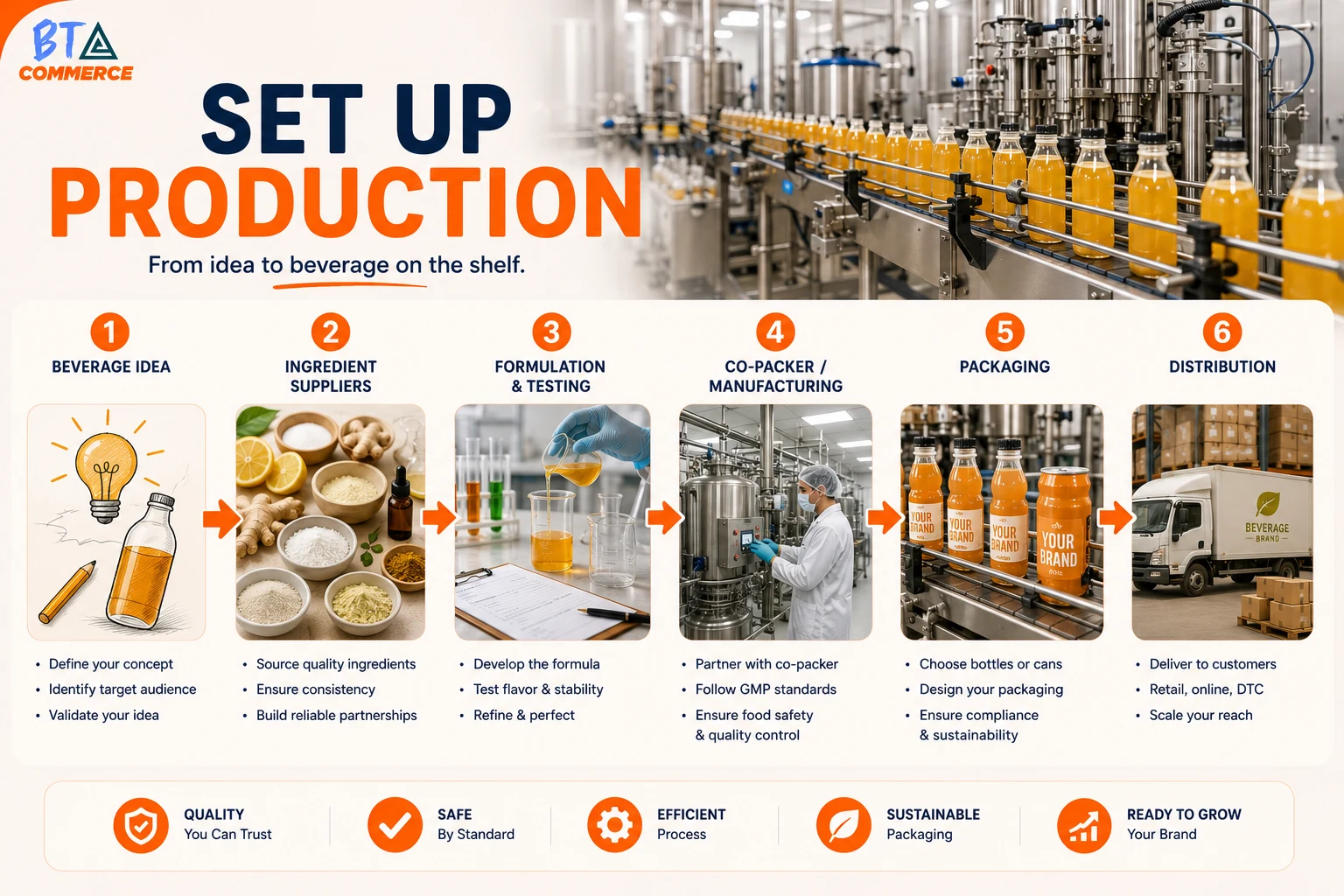
Starting with smaller production runs allows you to identify potential issues, refine your manufacturing process, and scale production more efficiently as demand increases.
6. Register Your Business
Before selling your beverage, ensure your business complies with all applicable legal and food safety requirements. Completing the necessary registrations before launch helps you avoid regulatory issues and makes it easier to work with manufacturers, distributors, and retailers.
Focus on the following tasks:
- Choose a business structure: Select a legal entity, such as a sole proprietorship, partnership, or Limited Liability Company (LLC), based on your liability protection, tax obligations, and future business plans.
- Register your business: Register your company with the appropriate government authority and obtain any required tax identification numbers, such as an Employer Identification Number (EIN) if operating in the United States.
- Obtain required licenses and permits: Apply for the business licenses, food manufacturing permits, health permits, or sales tax registrations required by your jurisdiction before producing or selling beverages.
- Comply with food safety and labeling regulations: If you manufacture packaged beverages, ensure your facility and products comply with applicable food safety regulations. In the United States, this may include FDA Food Facility Registration, FDA labeling requirements, food safety plans, and allergen controls. Your labels should include required information such as ingredient statements, allergen declarations, Nutrition Facts, and other mandatory label details.
- Protect your intellectual property: Register a trademark for your business name, logo, and product names to help protect your brand as your business grows.
Completing these requirements early makes it easier to expand into wholesale, retail, and new markets while maintaining regulatory compliance.
7. Build Your Brand
Your product may convince customers to buy once, but your brand is what encourages them to buy again. A consistent visual identity helps consumers recognize your beverage across store shelves, online stores, and marketing channels.
Focus on the following tasks:
- Create your brand identity: Develop consistent brand guidelines, including your visual style, color palette, typography, tone of voice, and messaging to create a cohesive brand experience across every customer touchpoint.
- Design your logo: Create a memorable logo that reflects your brand identity and works consistently across product labels, packaging, websites, social media, and promotional materials.
- Design product packaging: Create packaging graphics that attract attention, communicate your product’s benefits, reinforce your brand identity, and comply with labeling requirements while standing out on retail shelves.
- Build your online presence: Launch a professional website and establish active social media profiles to showcase your products, share your brand story, engage with customers, and support direct-to-consumer (DTC) sales.
A recognizable brand builds customer trust, increases brand awareness, and gives your beverage a stronger competitive advantage as your business grows.
8. Establish Distribution
Getting your beverage into the right sales channels is essential for generating revenue and building long-term growth. A strong distribution strategy starts with proving demand in smaller markets before expanding into larger retail networks.
Focus on the following tasks:
- Choose your sales channels: Decide where customers will purchase your beverage, including direct-to-consumer (DTC) channels, local retailers, grocery stores, cafes, restaurants, gyms, and specialty shops.
- Start with local distribution: Launch in smaller markets such as farmers’ markets, independent cafes, local stores, or health-focused retailers to test product demand, collect customer feedback, and build sales history before approaching larger accounts.
- Select a distribution model: Choose between self-distribution / Direct-to-Store Delivery (DSD), where you manage retailer relationships and deliveries yourself, or third-party distributors, which help you reach wider markets but require strong sales support to maintain product movement.
- Optimize logistics and inventory: Work with beverage-focused logistics providers to manage warehousing, transportation, inventory tracking, and cold-chain logistics if your product requires temperature-controlled storage.
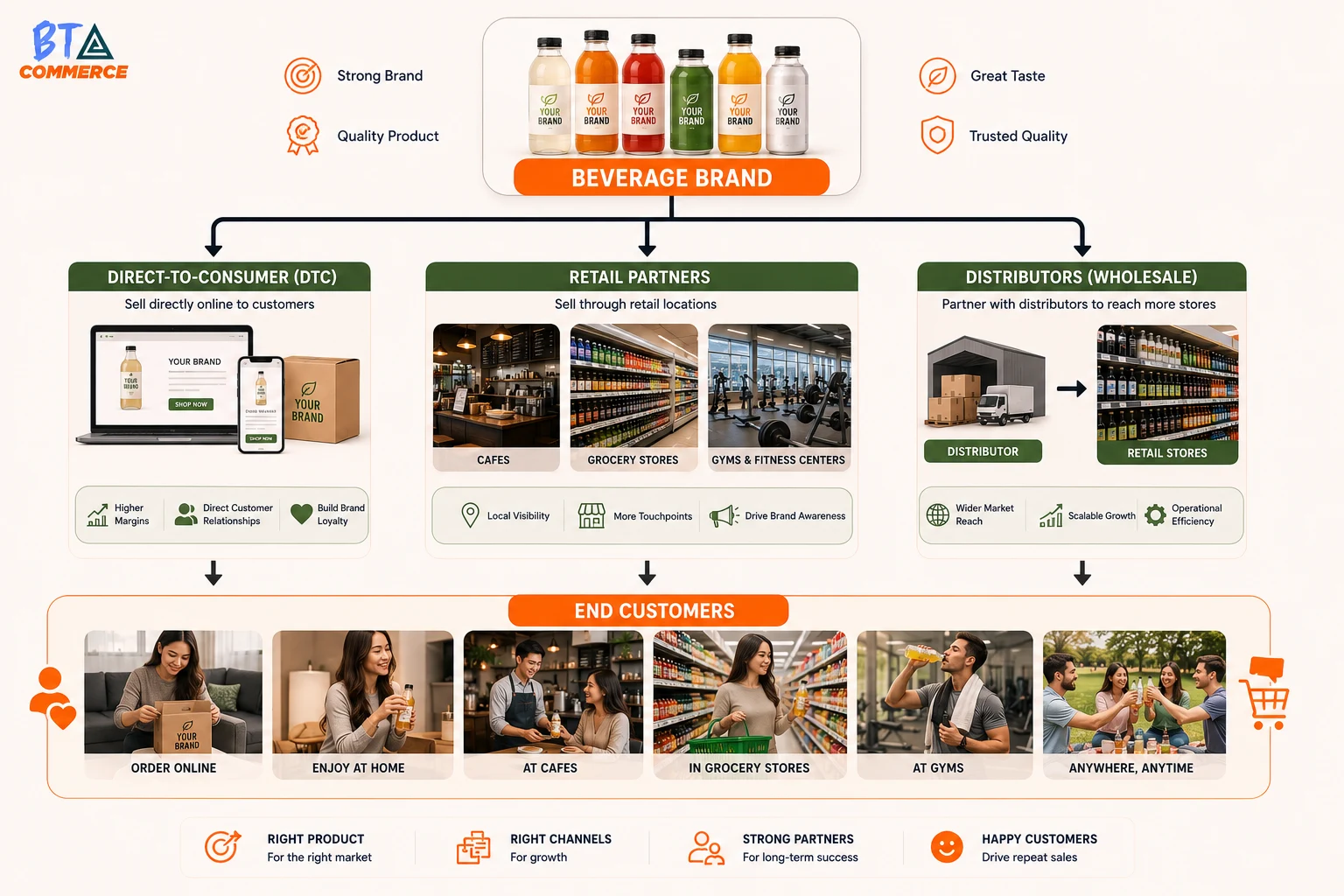
Building distribution gradually helps you create retail demand, improve operational efficiency, and avoid expanding into channels before your business is ready.
9. Launch Your Business
Launching a beverage business requires turning your preparation into real customer demand. A successful launch combines marketing activities, initial sales channels, and continuous product improvement based on customer response.
Focus on the following tasks:
- Execute your go-to-market strategy: Launch your beverage through selected channels, such as your online store, local retailers, cafes, gyms, or community events, to introduce your product to your target customers.
- Promote your beverage brand: Use social media campaigns, influencer partnerships, sampling events, local promotions, and customer-generated content to increase awareness and encourage first purchases.
- Establish your online storefront: Create an e-commerce website using platforms such as Shopify or other ecommerce solutions to support DTC sales, manage orders, and build direct relationships with customers.
- Monitor early performance: Track sales volume, customer reviews, repeat purchases, retailer feedback, and product quality to identify what works and make improvements quickly.
- Refine your product and strategy: Use customer insights to adjust marketing messages, sales approaches, packaging presentation, or product offerings based on real market feedback.
A successful launch is not only about generating initial sales but also about learning from customers and creating a repeatable growth strategy.
10. Scale Your Business
Scaling a beverage company requires increasing production, expanding distribution, and improving operations while maintaining product quality and profitability.
Focus on the following tasks:
- Expand production capacity: Move from small-batch production to larger-scale manufacturing by partnering with experienced co-packers, contract manufacturers, or OEM partners that can support higher volumes without the cost of building your own facility.
- Strengthen your supply chain: Develop relationships with multiple ingredient and packaging suppliers to reduce supply risks, improve purchasing flexibility, and support consistent production as demand grows.
- Maintain quality control: Implement standardized quality assurance processes across manufacturing, storage, and distribution to ensure every batch delivers consistent taste, safety, and performance.
- Expand distribution channels: Grow beyond initial markets by entering new retail locations, food service channels such as hotels and restaurants, online marketplaces, and additional geographic regions.
- Improve operational efficiency: Use technology such as an Order Management System (OMS) and inventory management tools to track orders, synchronize inventory, automate administrative tasks, and improve cash flow management.
Sustainable scaling requires expanding based on proven demand rather than increasing production or distribution too quickly. A controlled growth strategy helps protect your brand reputation while building a stronger beverage company.
Starting a Beverage Business FAQs
How much does it cost to start a beverage business?
The cost to start a beverage business typically ranges from $10,000 to over $100,000, depending heavily on your production scale, formula complexity, and go-to-market strategy.
- Low-End Startup ($10,000 – $30,000): Suitable for bootstrapping, small-batch local production (e.g., selling at farmers’ markets or local cafes), self-distribution, and minimal initial marketing.
- Mid-to-High End Startup ($50,000 – $150,000+): Required if you are utilizing a commercial co-packer (which often demands high minimum order quantities or MOQs), professional branding, regulatory lab testing, legal and trademark registration, and broader marketing campaigns.
Can I start a beverage company with no money?
Starting a beverage company with strictly zero capital is nearly impossible because physical product businesses require upfront costs for ingredients, packaging, testing, and legal compliance. However, you can start with very low capital by using smart financial strategies:
- Pre-selling and Crowdfunding: Use platforms like Kickstarter or Indiegogo, or launch a direct-to-consumer (DTC) pre-order campaign to validate demand and secure customer funds before manufacturing.
- Bootstrapping Small Batches: Begin by producing small batches locally (if permitted by cottage food laws or commercial kitchen rentals) rather than paying a co-packer for thousands of units upfront.
- Strategic Partnerships: Seek out angel investors, food and beverage incubators, or business partners who can provide capital in exchange for equity.
Do I need FDA approval to sell beverages?
In the United States, the FDA does not “approve” food and beverage products before they hit the market. Instead, the FDA regulates the facilities that manufacture, process, pack, or hold food and beverages.
Your legal responsibilities include:
- FDA Facility Registration: If you manufacture, process, or pack beverages for consumption in the US, your facility must be registered with the FDA.
- Compliance with Current Good Manufacturing Practices (cGMPs): Ensuring your production environment meets strict sanitation and safety standards.
- Label Compliance: Your product labels must strictly adhere to FDA guidelines, featuring accurate ingredient statements, allergen declarations, and a mandatory Nutrition Facts panel.
Should I manufacture beverages myself or use a co-packer?
Whether to manufacture in-house or use a co-packer depends on your budget, production volume, and long-term goals:
- In-House Production: Best for early-stage testing, small local runs, and maximum control over the process. However, it is labor-intensive and difficult to scale.
- Co-Packer (Contract Manufacturer): Best for commercial growth. Co-packers handle large-scale manufacturing, saving you from investing heavily in expensive equipment and facility build-outs. However, they require higher startup capital due to minimum order quantities (MOQs).
How long does it take to launch a beverage brand?
On average, launching a beverage brand takes anywhere from 6 months to over 1 year. The timeline is broken down across key phases:
- Concept & Formulation (2 to 4 months): Developing the recipe, ensuring shelf stability, and creating prototypes.
- Legal, Branding, & Business Planning (1 to 3 months): Registering your business, filing trademarks, designing packaging, and finalizing your business plan.
- Production & Supply Chain Setup (2 to 6 months): Sourcing ingredients, securing packaging, and completing production runs with your co-packer or facility.
Recommended Reading