Starting a consulting business is one of the most accessible ways to turn your expertise into a profitable business with relatively low startup costs. Whether you want to advise businesses, work independently, or build a consulting firm, success requires more than industry knowledge.
This guide explains how to start a consulting business step by step, from choosing your niche and business model to setting your pricing, registering your business, attracting clients, and building a sustainable consulting practice.
What Is a Consulting Business?
A consulting business provides expert advice and practical solutions that help startups, small businesses, and large organizations solve challenges, improve operations, develop business strategies, and achieve measurable results. Instead of selling products, consultants generate revenue by applying their expertise to analyze problems, recommend solutions, and often support implementation.
Consultants typically specialize in a specific niche, such as management, IT, marketing, finance, human resources (HR), operations, or sales consulting. Their services may include business assessments, strategic planning, process improvement, digital transformation, project implementation, employee training, and ongoing advisory services, depending on the client’s needs.
If you have proven expertise and strong analytical skills, and enjoy helping businesses make better decisions, consulting can be an excellent business to start. With relatively low startup costs, flexible business models, and growing demand across industries, it offers significant opportunities to build a profitable and scalable business.
Read more:
- 450+ Consulting Business Name Ideas (Unique & Professional)
- How to Start a Business in 10 Practical Steps to Succeed
- How to Start a Cleaning Business: A Step-by-Step Guide
How to Start a Consulting Business in 9 Steps
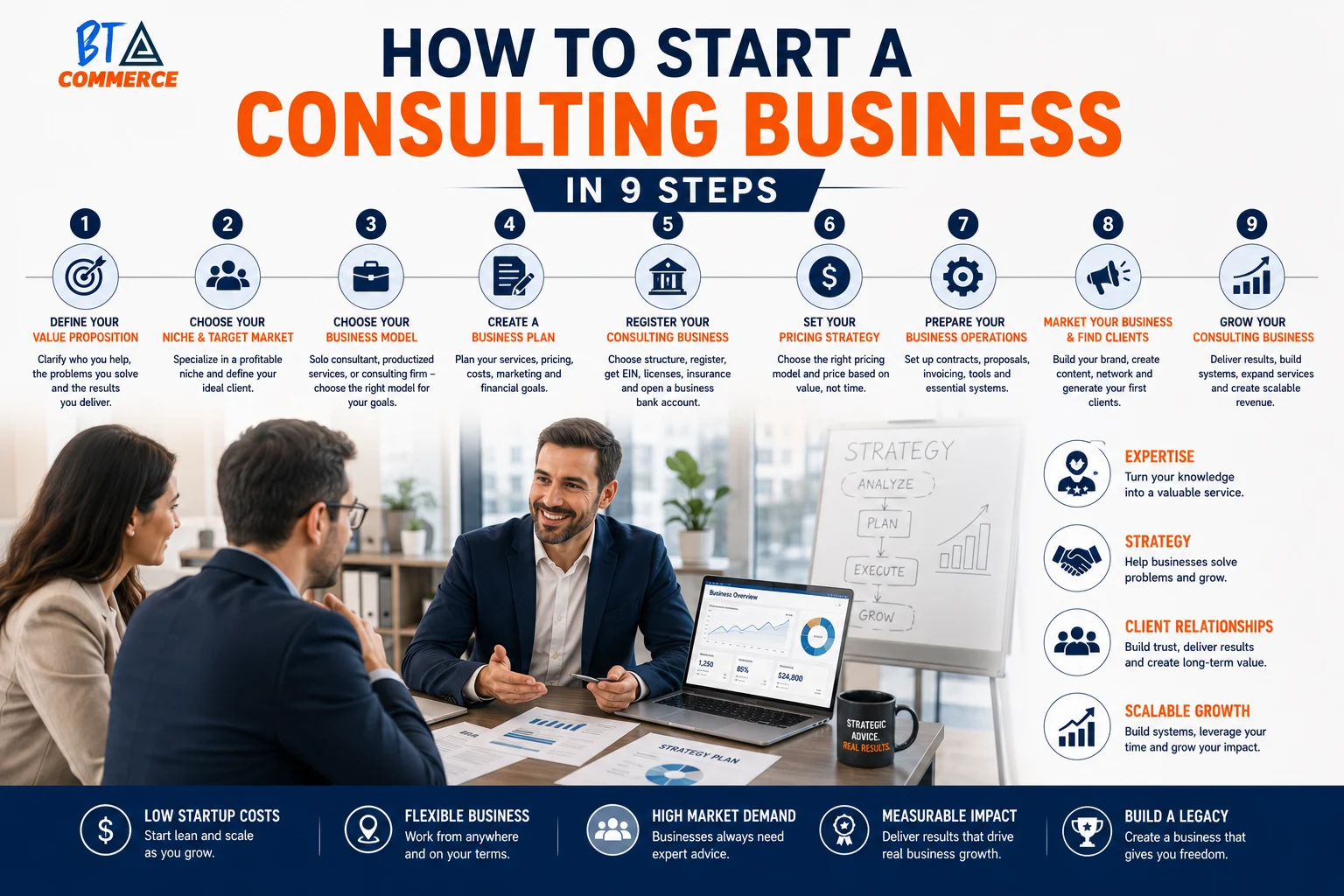
Step 1. Define Your Value Proposition
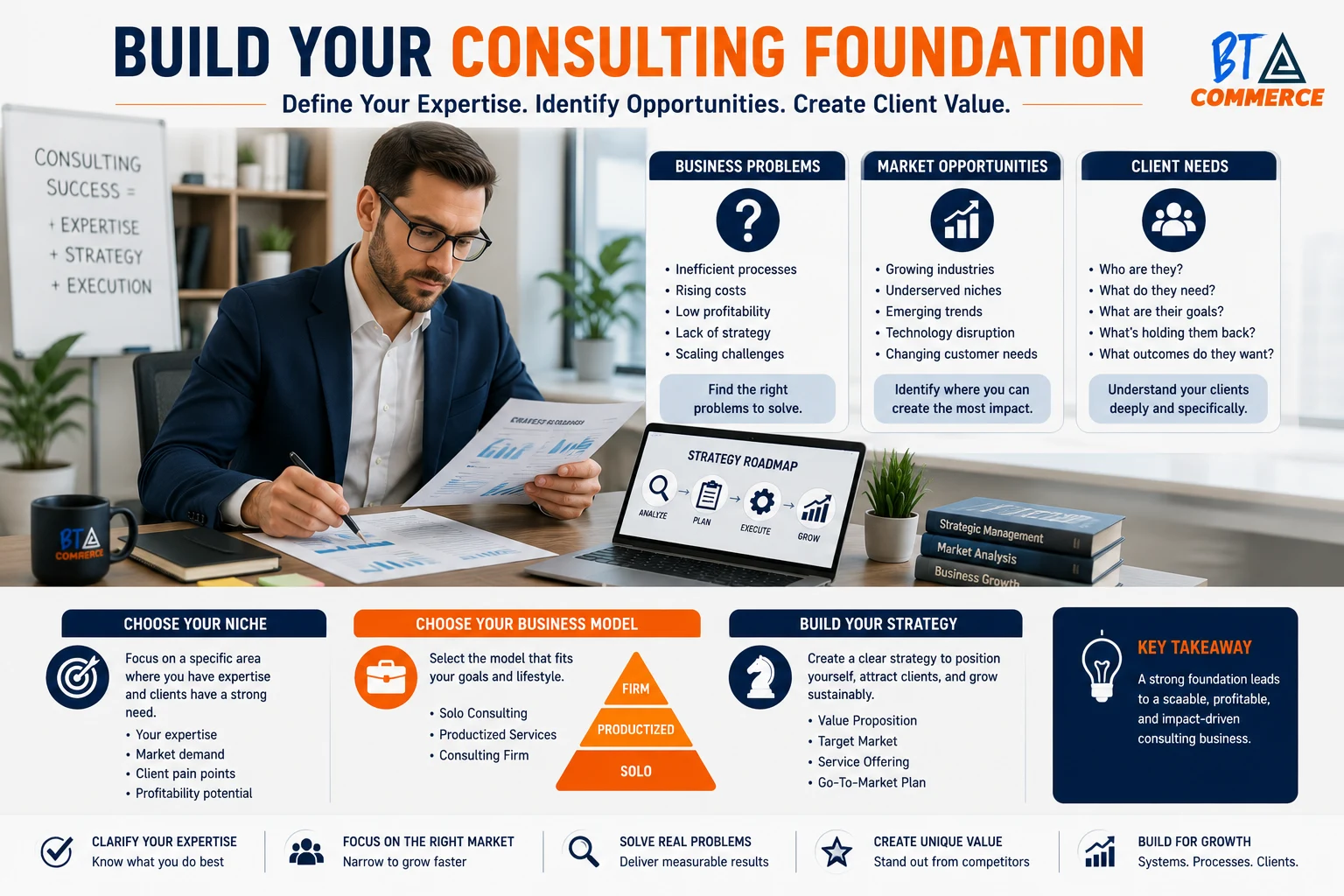
Your value proposition, also known as a Unique Selling Proposition (USP), is the reason clients choose your consulting business over competitors. It should clearly answer three questions:
- Who do you help?
- What business problems do you solve?
- What results can clients expect?
Instead of describing yourself with a general title like business consultant, define a specific area where you can deliver measurable value. The more focused your positioning, the easier it is for potential clients to understand your expertise and trust your services.
A strong value proposition typically includes:
- Target audience: Define the type of clients you help and the value you aim to provide.
- Core expertise: Management, IT, marketing, finance, HR, operations, or another consulting niche.
- Business problem: Reduce operating costs, improve workflow efficiency, increase sales, strengthen cybersecurity, or optimize marketing performance.
- Expected outcome: Higher revenue, lower costs, improved productivity, reduced business risks, or faster business growth.
Whenever possible, support your value proposition with measurable results. For example, saying “Help e-commerce businesses increase conversion rates by 20%” is far more persuasive than simply claiming to offer marketing consulting.
A simple formula you can use is:
I help [target market] solve [specific problem] so they can achieve [desired outcome] through [your expertise or methodology].
Before moving to the next step, test your value proposition with colleagues, former clients, or industry contacts. If they immediately understand who you help and the value you provide, you’re on the right track.
Step 2. Choose Your Niche and Target Market
One of the biggest mistakes new consultants make is trying to serve everyone. Instead, focus on a specific consulting niche and a well-defined target market. Specialization helps you build credibility faster, differentiate yourself from generalists, and often allows you to charge higher fees.
When choosing your niche, evaluate each opportunity based on these key factors:
- Experience: Do you have proven knowledge or industry experience?
- Market demand: Are businesses actively looking for solutions in this area?
- Access: Can you easily reach decision-makers through your network or industry connections?
- Profitability: Are clients willing to pay for the results you deliver?
Your target market should also be as specific as possible. Rather than targeting “small businesses,” define exactly who you’re trying to help.
For example, identify:
- Industry: Healthcare, manufacturing, retail, SaaS, e-commerce, finance, etc.
- Company size: Startups, small businesses, mid-sized companies, or enterprises.
- Decision-maker: Business owner, CEO, Marketing Director, HR Manager, Operations Manager, or another stakeholder.
- Primary pain points: Increasing revenue, reducing costs, improving operational efficiency, strengthening cybersecurity, or expanding into new markets.
Before committing to a niche, validate your idea by researching competitors and confirming there is real market demand. Review the services they offer, how they position themselves, who they target, and where gaps exist. You can also speak with potential clients or run a small pilot project to verify that businesses are willing to pay for your expertise before investing heavily in building your consulting business.
=> Read more: 25 Profitable Consulting Business Ideas to Start
Step 3. Choose Your Consulting Business Model
Your consulting business model defines how you deliver your services, work with clients, and grow your business over time. Choosing the right model early helps you build efficient workflows, set clear client expectations, and create a foundation for long-term growth.
The three most common consulting business models are:
- Solo consulting: You work directly with clients and deliver customized solutions yourself. This is the easiest model to start because it requires minimal setup and allows you to monetize your existing expertise quickly. However, your income and capacity are limited by the number of hours you can personally work.
- Productized consulting: Instead of offering open-ended consulting, you package your expertise into a standardized service with a clearly defined scope and outcome, such as a business audit, marketing strategy, or IT security assessment. Standardized services make your sales process more consistent and easier for clients to understand.
- Consulting firm: You build repeatable systems, develop proven methodologies, and hire consultants or contractors to deliver services. Rather than handling every client engagement yourself, you focus on business development, client acquisition, and growing a scalable business.
Next, decide how you’ll deliver your consulting services. Online consulting allows you to work remotely with clients anywhere using virtual meetings and collaboration tools, while in-person consulting is better suited for workshops, on-site assessments, implementation projects, or businesses that require face-to-face collaboration.
Step 4. Create a Consulting Business Plan
A consulting business plan serves as your roadmap for launching and growing your business. It doesn’t need to be overly complex, but it should clearly define your services, target market, revenue strategy, financial goals, and growth plan so you can make informed business decisions.
Your business plan should include these essential sections:
- Services you’ll offer: Clearly define your consulting services, deliverables, and the business problems you solve for clients.
- Revenue model: Define how your consulting business will generate revenue and which service structure supports your goals.
- Startup costs: Estimate your initial expenses, such as business registration, insurance, website development, software subscriptions, marketing, and professional tools.
- Financial goals: Set realistic revenue targets, operating expense budgets, and profit margin goals for your first 12–24 months.
- Marketing and growth plan: Outline how you’ll attract clients through networking, referrals, content marketing, SEO, LinkedIn, partnerships, or other lead generation channels.
Keep your business plan practical and update it as your consulting business evolves. A well-structured plan helps you stay focused, measure progress, and identify new growth opportunities as your client base expands.
Related guide: If you need a detailed framework, templates, and examples, read our complete Consulting Business Plan guide.
Step 5. Register Your Consulting Business
Registering your consulting business establishes it as a legal entity, protects your personal assets, and ensures compliance with tax and reporting requirements. While regulations vary by location, most consultants should complete the following steps before working with clients.
- Choose a business structure: The most common options are Sole Proprietorship, Limited Liability Company (LLC), and Corporation (C Corp or S Corp). An LLC is a popular choice because it separates your personal and business assets. In the U.S., forming an LLC typically requires filing Articles of Organization with your state’s Secretary of State.
- Register your business: Complete the required business registration in your jurisdiction. If you operate under a name different from your legal name, register a DBA (Doing Business As), also known as a trade or fictitious business name.
- Apply for an Employer Identification Number (EIN): An Employer Identification Number (EIN) issued by the Internal Revenue Service (IRS) is generally required for LLCs and corporations. Even sole proprietors often obtain an EIN to open a business bank account and avoid using their Social Security Number on documents such as Form W-9.
- Obtain licenses and permits: Depending on your location, you may need a general business license, Home Occupation Permit, or other local permits before operating your consulting business.
- Meet tax and reporting requirements: Check with your state’s Department of Revenue to determine whether your consulting services are subject to sales tax. If you plan to hire employees, register with the Department of Labor for payroll tax withholding and unemployment insurance. Many LLCs and corporations in the U.S. must also file a Beneficial Ownership Information (BOI) report with the Financial Crimes Enforcement Network (FinCEN).
- Open a business bank account: Keeping business and personal finances separate simplifies bookkeeping, tax filing, cash flow management, and financial reporting.
Completing these legal, tax, and financial requirements early helps your consulting business operate professionally, remain compliant, and build trust with clients from day one.
Step 6. Set Your Pricing Strategy
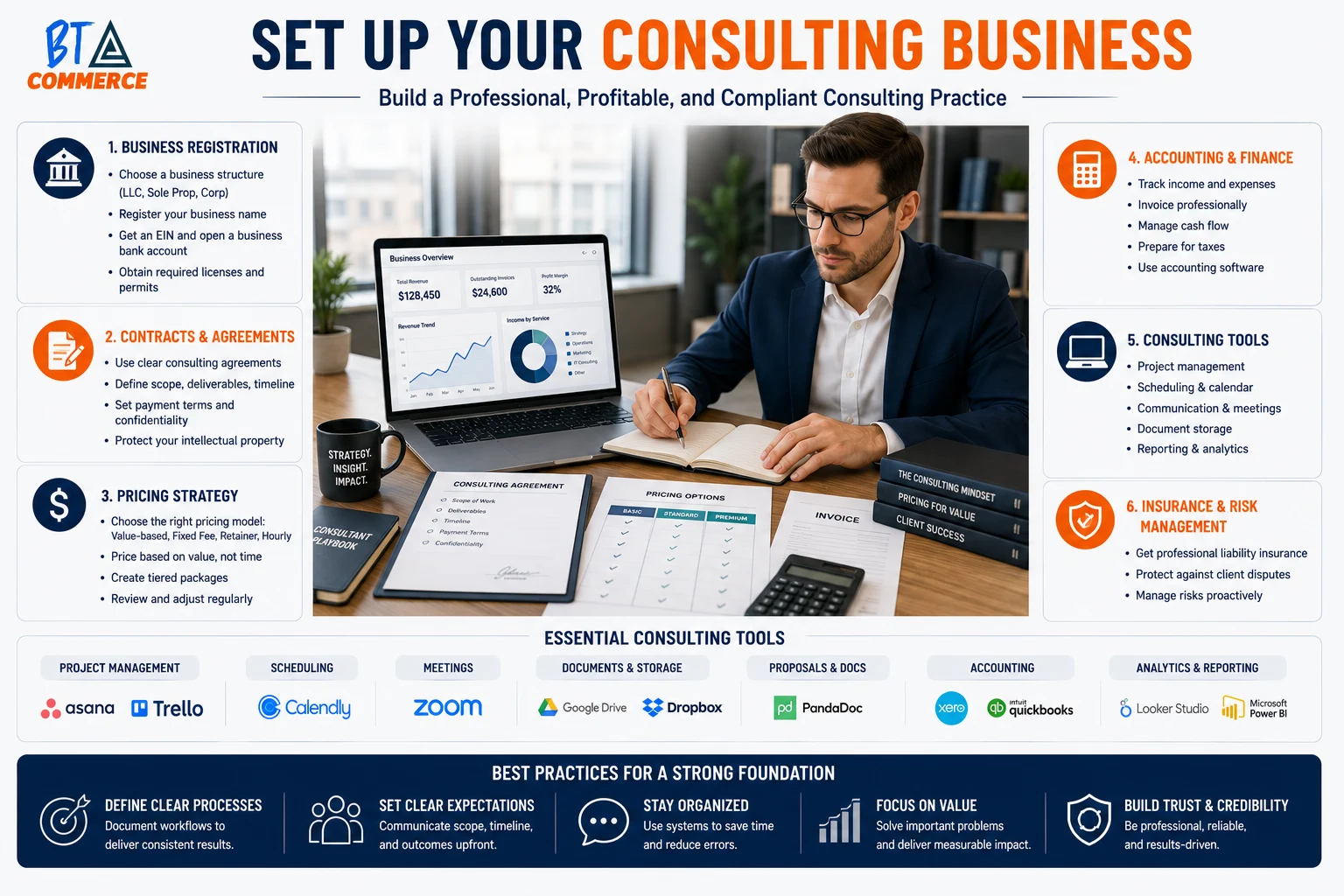
Your pricing strategy should reflect the value you deliver rather than the time you spend working. Choose a billing model that matches your consulting niche, project scope, and client expectations, then set rates that fairly compensate you for the business outcomes you create.
The most common consulting pricing models include:
- Value-based pricing: Charge based on the financial value, revenue increase, or return on investment (ROI) your consulting generates. This model works best when you can demonstrate measurable business results.
- Fixed-price (project) pricing: Charge a single, all-inclusive fee for a clearly defined deliverable, such as a 30-day marketing audit, business assessment, or implementation roadmap.
- Retainer pricing: Charge a flat monthly fee for ongoing advisory services, strategic support, or a predetermined number of consulting hours, providing predictable recurring cash flow.
- Hourly pricing: Bill clients for the time worked. Although it’s the easiest model to calculate, it limits your earning potential because your income is tied directly to billable hours.
When establishing your rates, consider your expertise, project complexity, operating costs, taxes, target income, competitor pricing, and the ROI you deliver. If you use hourly pricing, calculate a minimum baseline by adding your desired annual salary, benefits, taxes, and overhead, then dividing the total by approximately 1,500 billable hours per year.
Increase perceived value by offering tiered service packages (such as Good, Better, Best) and combining strategic consulting with done-for-you implementation or ongoing support. Clearly define the Scope of Work (SOW), including deliverables, meetings, timelines, revision limits, and project boundaries, and require a formal change order for work outside the agreed scope.
Avoid underpricing your services to win clients. Instead, use your early projects to build documented results, case studies, and client testimonials, then gradually increase your fees as your expertise, credibility, and proven outcomes grow.
Step 7. Prepare Your Business Operations
Before working with clients, set up the operational systems that help your consulting business run efficiently and protect your professional interests. Well-defined processes save time, improve the client experience, and reduce legal and financial risks.
Prepare the following essentials before launching:
- Client contracts and agreements: Never start a project without a written agreement. Your contract should clearly define the scope of work, deliverables, payment terms (such as Net 15 or Net 30), project timelines, confidentiality, and ownership of intellectual property.
- Consulting proposals: Create reusable proposal templates that outline the client’s challenges, your recommended solution, project scope, timeline, deliverables, pricing, and expected outcomes. A professional proposal helps set clear expectations before work begins.
- Invoicing and accounting: Use accounting software such as FreshBooks or Xero to manage invoices, monitor project profitability, track business expenses, and prepare for tax filing. Keep your business finances separate by using a dedicated business bank account and business credit card.
- Essential consulting tools: Build a simple tech stack to manage your daily operations. Popular tools include Asana or Trello for project management, Calendly for meeting scheduling, and Zoom for virtual client meetings. If you work remotely, a dedicated home office can also provide a cost-effective and flexible workspace.
Finally, verify any local licensing requirements before serving clients. Depending on your location, you may need a general business license, local permits, or professional liability insurance (Errors and Omissions Insurance) to protect your consulting business.
Step 8. Market Your Consulting Business and Find Your First Clients
Marketing your consulting business is about building credibility and creating a reliable pipeline of qualified leads. Start with people who already trust your expertise, then expand through content, networking, and targeted outreach.
Focus on these strategies:
- Build your brand: Define a clear brand identity that communicates your consulting niche, expertise, and the measurable business outcomes you help clients achieve.
- Create a professional website: Showcase your services, value proposition, industries served, and contact information. Include case studies, client testimonials, and measurable results to strengthen credibility.
- Optimize your LinkedIn profile: Turn your LinkedIn profile into a landing page by highlighting your experience, certifications, client outcomes, and thought leadership.
- Leverage networking and referrals: Reach out to former colleagues, past employers, and industry contacts with personalized messages explaining your niche and the specific business problems you solve, rather than asking for general referrals.
- Use content marketing: Publish industry insights, trend analysis, practical guides, and case studies to demonstrate expertise, build authority, and improve online visibility.
- Generate leads through targeted outreach: Build a list of 20–50 ideal companies, identify decision-makers such as a VP of Operations or Chief Marketing Officer (CMO), and personalize your outreach via LinkedIn or email. Offer a paid micro-engagement—such as an SEO audit, HR assessment, or strategy workshop—to reduce client risk, deliver quick wins, and position your services for a larger project or ongoing retainer.
After each successful engagement, request testimonials and develop a case study highlighting the measurable ROI or business improvements you delivered. These assets become some of your most effective tools for attracting future consulting clients.
Step 9. Grow Your Consulting Business
Growing a consulting business means moving beyond trading time for money and building systems that support long-term growth. As your client base expands, focus on improving efficiency, increasing the value of your services, and creating scalable revenue streams.
Here’s how to grow sustainably:
- Deliver excellent client experiences: Consistently produce measurable results, communicate proactively, and exceed client expectations. Satisfied clients are more likely to provide repeat business, referrals, testimonials, and case studies that strengthen your reputation.
- Build systems and automation: Document repeatable workflows and delegate administrative tasks such as scheduling, data entry, and research to virtual assistants or freelancers. Tools like Upwork and Fiverr can help you find qualified professionals while avoiding the overhead of full-time employees.
- Expand your services: Transition from hourly work to value-based pricing and package your expertise into standardized offers. You can also scale by launching group coaching, online courses, licensing proprietary frameworks, or offering digital tools that allow you to serve more clients without increasing billable hours.
- Hire contractors or employees when needed: As demand grows, bring in specialized subcontractors or employees to increase delivery capacity while maintaining service quality. This allows you to focus on strategy, business development, and client relationships rather than day-to-day execution.
Finally, establish thought leadership by consistently publishing articles, podcasts, webinars, or speaking at industry events. Becoming a recognized expert in your niche helps attract qualified inbound leads and supports long-term business growth.

Starting a Consulting Business FAQs
How much does it cost to start a consulting business?
You can start a consulting business for under $1,000 in many cases. This usually covers basic costs such as business registration, a domain name, website setup, accounting software, and essential tools. Expenses can increase if you hire employees, rent office space, run paid marketing campaigns, or use specialized software.
Can I start a consulting business with no experience?
Yes, you can start a consulting business without formal consulting experience if you have valuable industry knowledge or transferable skills. Focus on a specific niche, start with smaller projects or paid audits, and build credibility through certifications, case studies, and client testimonials.
Can I start a consulting business as an LLC?
Yes. An LLC (Limited Liability Company) is a popular structure for consulting businesses because it helps separate personal assets from business liabilities. However, consultants may also start as a sole proprietorship depending on their risk level, tax situation, and growth plans.
Is there a difference between a consulting business, consulting firm, and consulting company?
The terms are often used interchangeably. A consulting business refers to any business that provides professional advice and solutions, while a consulting firm or consulting company usually refers to a larger organization with multiple consultants, structured services, and scalable operations.
How long does it take to get your first consulting clients?
You can get your first consulting clients within weeks if you already have a strong professional network. For many new consultants, building a consistent client pipeline takes several months through networking, LinkedIn outreach, referrals, and content marketing. Starting with smaller engagements can help shorten the process.
Recommended Reading