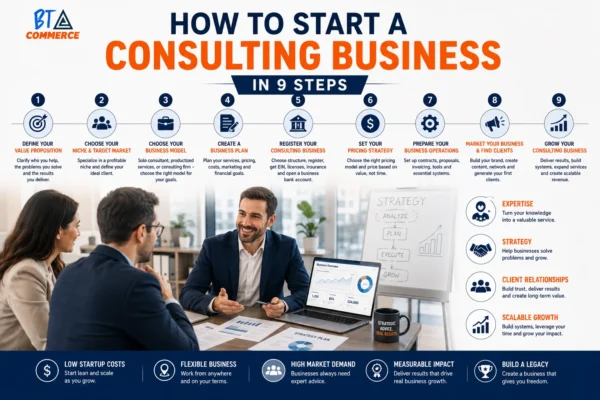
A consulting business plan provides a clear roadmap for defining your services, identifying your target clients, developing effective marketing strategies, and setting realistic financial goals. It helps transform your expertise into a structured business with a clear direction for growth.
Whether you’re launching an independent consulting practice or building a consulting firm, a well-crafted plan supports better decision-making, attracts the right clients, and creates a strong foundation for long-term success.
Executive Summary
The executive summary provides a high-level overview of your consulting business plan, helping readers quickly understand your business before reviewing the details. Although it appears at the beginning of the document, it’s typically written after completing the rest of the business plan to ensure it accurately reflects your overall strategy.
A strong executive summary should briefly cover the following elements:
- Business overview: Introduce your consulting business, including its purpose, business structure, and consulting specialization.
- Mission statement: Explain your business purpose and the value you aim to deliver to clients.
- Business objectives: Summarize your short- and long-term goals, such as client acquisition, revenue growth, or business expansion.
- Target market: Identify your ideal clients and the problems your consulting services solve.
- Core consulting services: Briefly describe the services your business provides.
- Competitive advantage: Highlight what sets your consulting business apart, such as industry expertise, specialized methodologies, or measurable results.
- Financial highlights: Provide a snapshot of your revenue model, startup costs, financial projections, or funding needs, if applicable.
Keep your executive summary clear and concise. It should present a compelling snapshot of your consulting business while leaving the detailed explanations for the sections that follow.

Read more:
- How to Write a Business Plan for Startups & Small Businesses
- 25 Profitable Consulting Business Ideas to Start
- How to Start a Consulting Business: A Step-by-Step Guide
- 450+ Consulting Business Name Ideas (Unique & Professional)
Step 1. Choose Your Consulting Business Model
Before defining your services or setting your pricing, decide what type of consulting business you want to build. Your business model determines how you deliver value, work with clients, generate revenue, and scale your business over time. Choosing the right model early also helps you make better decisions about operations, marketing, and long-term growth.
When selecting a consulting business model, consider your expertise, preferred working style, available resources, and business goals. If you’re starting as an independent consultant, it’s often better to focus on one model first and expand as your business grows.
Common Consulting Business Models:
| Business Model | Description | Best For |
|---|---|---|
| Solo Consulting | You manage every aspect of the business, from client acquisition and service delivery to administration and marketing. | Independent consultants and new consulting businesses. |
| Consulting Firm | You build a team of consultants and support staff to serve multiple clients while focusing on business growth and management. | Businesses planning to scale and expand their capacity. |
| Productized Consulting | You package your expertise into standardized services with a fixed scope and pricing, making them easier to sell and deliver. | Consultants with repeatable processes and clearly defined solutions. |
| Hybrid Consulting | You combine two or more business models, such as offering standardized consulting packages while continuing to provide custom consulting services. | Established consulting businesses looking to diversify revenue streams. |
After selecting your business model, decide how you’ll deliver your consulting services to clients. Common engagement approaches include:
- Project-based consulting: Fixed-scope engagements with defined deliverables and timelines.
- Retainer consulting: Ongoing advisory services for a recurring monthly or quarterly fee.
- Hourly consulting: Flexible billing based on the time spent providing advice or specialized expertise.
There’s no single best consulting business model. The right choice depends on your specialization, target market, growth objectives, and the type of client relationships you want to build. Many consulting businesses start with a solo model and project-based engagements before expanding into productized services, retainers, or a larger consulting firm as demand grows.
Step 2. Define Your Consulting Services and Ideal Clients
A profitable consulting business starts with clearly defining what you offer and who you help. Aligning your consulting services with the right target clients strengthens your value proposition, improves your marketing, and makes it easier to win high-value engagements.
Define Your Consulting Services
Instead of simply listing your services, explain the business problems you solve and the results clients can expect.
Include:
- Core consulting services: Your primary expertise, such as strategy, operations, finance, marketing, HR, or technology consulting.
- Service packages: Group services into structured offers, such as business assessments, strategic planning, implementation, or ongoing advisory support.
- Client outcomes: Focus on measurable results, including increased revenue, improved efficiency, lower costs, or accelerated business growth.
- Different service levels: Offer entry-level assessments, comprehensive consulting projects, and long-term advisory retainers to meet different client needs.
Each service should clearly answer three questions: What problem does it solve? Who is it for? What outcome will the client achieve?
Identify Your Ideal Clients
Avoid trying to serve every business. Instead, define a specific ideal client profile that aligns with your expertise.
Your target audience should include:
- Industry or niche: The markets where you deliver the greatest value.
- Company size: Startups, SMBs, mid-sized businesses, or enterprises.
- Decision-makers: Business owners, CEOs, executives, department heads, or HR directors.
- Customer problems: The operational, financial, marketing, or organizational challenges your consulting services address.
- Client needs: The goals they want to achieve, such as improving profitability, increasing efficiency, expanding into new markets, or scaling operations.
A well-defined consulting service combined with a focused ideal client profile helps differentiate your business, improve client acquisition, and build long-term consulting relationships.
Step 3. Analyze Your Market and Build Your Competitive Positioning
Understanding your market helps you identify the right opportunities and position your consulting business more effectively. By analyzing customer demand, competitor offerings, and market gaps, you can develop a clear unique value proposition (UVP) that explains why clients should choose your services over competing consultants.
Analyze Your Market
Start by researching the market you’ll serve rather than making broad assumptions.
Focus on:
- Market segmentation: Divide your market by industry, company size, geographic location, or business needs to identify your most valuable client segments.
- Industry demand: Evaluate whether demand for your consulting specialization is growing and identify the trends driving that demand.
- Customer buying behavior: Understand what motivates businesses to hire consultants, including their decision-making process, budget considerations, and expected outcomes.
- Competitor analysis: Identify direct and indirect competitors, compare their services, pricing models, positioning, and client feedback, then look for underserved markets or unmet customer needs.
Build Your Competitive Positioning
Once you understand the market, define how your consulting business stands out.
Your positioning should clearly communicate:
- Unique value proposition (UVP): A concise statement explaining who you help, the problem you solve, and why your solution is different.
- Consulting differentiation: Highlight your competitive advantages, such as industry expertise, specialized methodologies, faster implementation, personalized service, or measurable business results.
- Why clients choose your services: Demonstrate the value clients receive, whether it’s solving complex challenges, reducing costs, improving operational efficiency, accelerating growth, or delivering a stronger return on investment (ROI).
A strong competitive position isn’t about offering more services than your competitors—it’s about becoming the best choice for a specific type of client with a specific business challenge. The clearer your market focus and value proposition, the easier it becomes to attract qualified leads and build a sustainable consulting business.
Step 4. Set Your Pricing Strategy and Revenue Model
Your pricing strategy determines how you charge for consulting services, while your revenue model defines how your business generates income. Choose pricing methods that reflect the value and ROI (Return on Investment) you deliver rather than simply billing for time.
Choose Your Pricing Strategy
Select a pricing model based on your engagement type and expected client outcomes.
| Pricing Model | Best For | Key Benefit |
|---|---|---|
| Hourly pricing | Discovery sessions or undefined scopes | Flexible short-term billing |
| Project-based pricing | Fixed deliverables and timelines | Predictable pricing for both parties |
| Retainer pricing | Ongoing advisory or Fractional COO services | Stable recurring revenue |
| Value-based pricing | High-impact consulting with measurable ROI | Fees tied to business value, not hours worked |
When setting your rates, consider your specialization, project complexity, market demand, competitor pricing, and the measurable value your services create.
Build Your Revenue Model
Create multiple revenue streams to improve business stability.
- Core consulting services: Project-based, retainer, or value-based engagements.
- Productized consulting: Fixed-price services such as a Strategy Audit or Business Plan Review.
- Digital products: Templates, online courses, workshops, or subscription resources.
You can also organize your offers into Basic, Standard, and Premium packages to serve different client budgets and business needs.
Price for Profitability
Before setting your fees, calculate a minimum profitable rate based on your Target Personal Income, Overhead Expenses, Desired Profit, and Projected Billable Hours. While many consultants work around 2,000 hours annually, only 1,000–1,200 hours are typically billable after accounting for marketing, administration, and business development.
Finally, establish clear payment terms. For project-based consulting, requesting a 30–50% upfront deposit followed by milestone payments and Net 15 or Net 30 invoice terms helps maintain healthy cash flow while reducing payment risk.
Step 5. Create Your Marketing and Client Acquisition Plan
A successful consulting business needs a consistent system for attracting and converting clients. This section of your consulting business plan explains how you’ll reach your ideal audience, demonstrate your expertise, and turn qualified prospects into long-term consulting engagements.
Build your marketing and client acquisition strategy around these five areas:
- Define your ideal customer profile (ICP): Identify the industries, company size, revenue range, and decision-makers you want to serve, such as business owners, CEOs, or department heads. A clearly defined audience helps focus your marketing efforts.
- Develop your value proposition: Write a concise statement explaining the business problems you solve, the measurable ROI (Return on Investment) you deliver, and what makes your consulting services different from competitors.
- Choose your acquisition channels: Focus on two or three channels that best reach your target clients. Common options include LinkedIn networking, content marketing through articles or case studies, industry events, strategic partnerships, and client referrals.
- Create your sales pipeline: Map out the journey from the first interaction to a signed consulting contract. Many consultants begin with a discovery call or paid diagnostic session before presenting a customized proposal for a larger engagement.
- Track performance and budget: Allocate approximately 10–15% of projected revenue to marketing activities and monitor key metrics such as Customer Acquisition Cost (CAC), conversion rate, qualified leads, and client acquisition costs. Regularly reviewing these metrics helps improve your marketing strategy and sales forecasts over time.
Step 6. Plan Your Operations and Financial Structure
A successful consulting business depends on efficient operations and realistic financial planning. This step outlines how you’ll deliver consulting services consistently, manage day-to-day activities, and build a financial foundation that supports long-term growth.
Plan Your Operations
Your operational plan should explain how your consulting business runs from the first client meeting to project completion.
Include:
- Business operations: Define a clear service delivery process, such as client discovery, business assessment, strategy development, implementation support, and post-project review.
- Team structure: Specify whether you’ll operate as an independent consultant, work with subcontractors, or build a consulting firm with employees as your business grows.
- Client management process: Establish a consistent workflow for onboarding clients, managing projects, communicating progress, and measuring client satisfaction.
- Business tools: Identify the software that supports your operations, including proposal software, video conferencing platforms, project management tools, CRM systems, and accounting software.
Use key performance indicators (KPIs) such as client retention rate or Net Promoter Score (NPS) to monitor service quality and continuously improve your consulting process.
Build Your Financial Structure
Your financial plan should demonstrate that your consulting business is both sustainable and profitable.
Include:
- Startup costs: Estimate one-time expenses such as business registration, licenses, insurance, hardware, website development, and initial marketing.
- Operating expenses: Budget for recurring costs, including software subscriptions, professional development, travel, and other business overhead.
- Revenue projections: Forecast revenue based on your pricing model, expected number of clients, and average project value over the next 3–5 years.
- Profit expectations: Estimate when your consulting business is expected to become profitable and monitor cash flow to ensure you have sufficient working capital. Calculating your break-even point also helps determine how many clients or projects are needed to cover operating costs.
A practical operational plan combined with realistic financial projections helps you manage growth more effectively while giving lenders, investors, or business partners greater confidence in your consulting business plan.
Step 7. Manage Risks and Set Business Growth Milestones
A successful consulting business should plan not only for growth but also for potential challenges. Identifying risks early and setting measurable milestones helps you make better decisions, adapt to market changes, and track progress toward long-term business goals.
Manage Business Risks
Every consulting business faces operational and financial risks. Prepare mitigation strategies for the most common challenges, including:
- Finding clients consistently: Reduce reliance on a few large contracts by maintaining a healthy sales pipeline, nurturing client relationships, and generating recurring revenue through retainer agreements.
- Competition: Differentiate your business with a clear specialization, strong value proposition, and measurable client results rather than competing primarily on price.
- Pricing challenges: Review your pricing regularly to ensure it reflects market conditions, your expertise, and the value you deliver.
- Cash flow issues: Maintain an operating cash reserve covering 3–6 months of business expenses and monitor spending to protect your business during slower periods.
Set Business Growth Milestones
Break your long-term vision into realistic milestones that can be measured over time.
A typical consulting business roadmap may include:
| Timeline | Example Milestones |
|---|---|
| Months 1–3 | Finalize your consulting niche, build a professional portfolio, and acquire your first 3–5 clients. |
| Months 4–6 | Reach a target monthly recurring revenue (MRR), such as $5,000–$10,000, and validate your core service offerings. |
| Months 7–12 | Improve lead generation, expand content marketing efforts, and achieve a 60–70% billable utilization rate. |
| Years 2–3 | Expand your team, introduce new consulting services, and increase annual revenue through scalable business systems. |
Review your progress regularly by tracking key metrics such as revenue growth, client acquisition, client retention, profitability, and overall business performance. Updating your consulting business plan as your business evolves helps ensure your growth objectives remain realistic and achievable.
=> Explore more: Clothing Business Plan for Boutique and Online Fashion Brands
Tips for Writing a Consulting Business Plan
A consulting business plan should be practical, realistic, and easy to execute. For most solo consultants and small firms, a lean business plan of 10–15 pages is usually enough to communicate your strategy and support early growth.
- Research your market and specialize. Instead of positioning yourself as a general business consultant, focus on a specific niche with clear demand. A specialized consulting business is easier to market and can often command higher fees.
- Keep your plan concise and actionable. Highlight your Unique Selling Proposition (USP), service offerings, pricing approach, and business goals without adding unnecessary detail.
- Set measurable goals with realistic financial projections. Base your revenue forecasts on achievable assumptions. Most consultants spend only 60–70% of their working time on billable client work, so account for administration, business development, and potential late client payments.
- Review and update your plan regularly. As your consulting business evolves, revise your services, pricing, target market, and financial projections to keep your business plan aligned with your long-term objectives.
Consulting Business Plan FAQs
Do I need a business plan if I’m a solo consultant?
Yes. A business plan helps you define your niche, services, pricing, target clients, and growth strategy, making it easier to win clients and grow your consulting business.
How long should a consulting business plan be?
For most solo consultants and small firms, 10–15 pages is enough to cover the essential business, marketing, and financial plans.
What should be included in a consulting business plan?
Include an executive summary, business model, services, target market, market analysis, pricing, marketing strategy, operations plan, financial plan, and business milestones.
What is the difference between a consulting business plan and a regular business plan?
A consulting business plan focuses on selling expertise and services, with greater emphasis on client acquisition, service delivery, pricing, and long-term client relationships.
Is a consulting business profitable?
Yes. With low startup costs, a clear niche, effective pricing, and consistent client acquisition, a consulting business can be highly profitable.
Recommended Reading