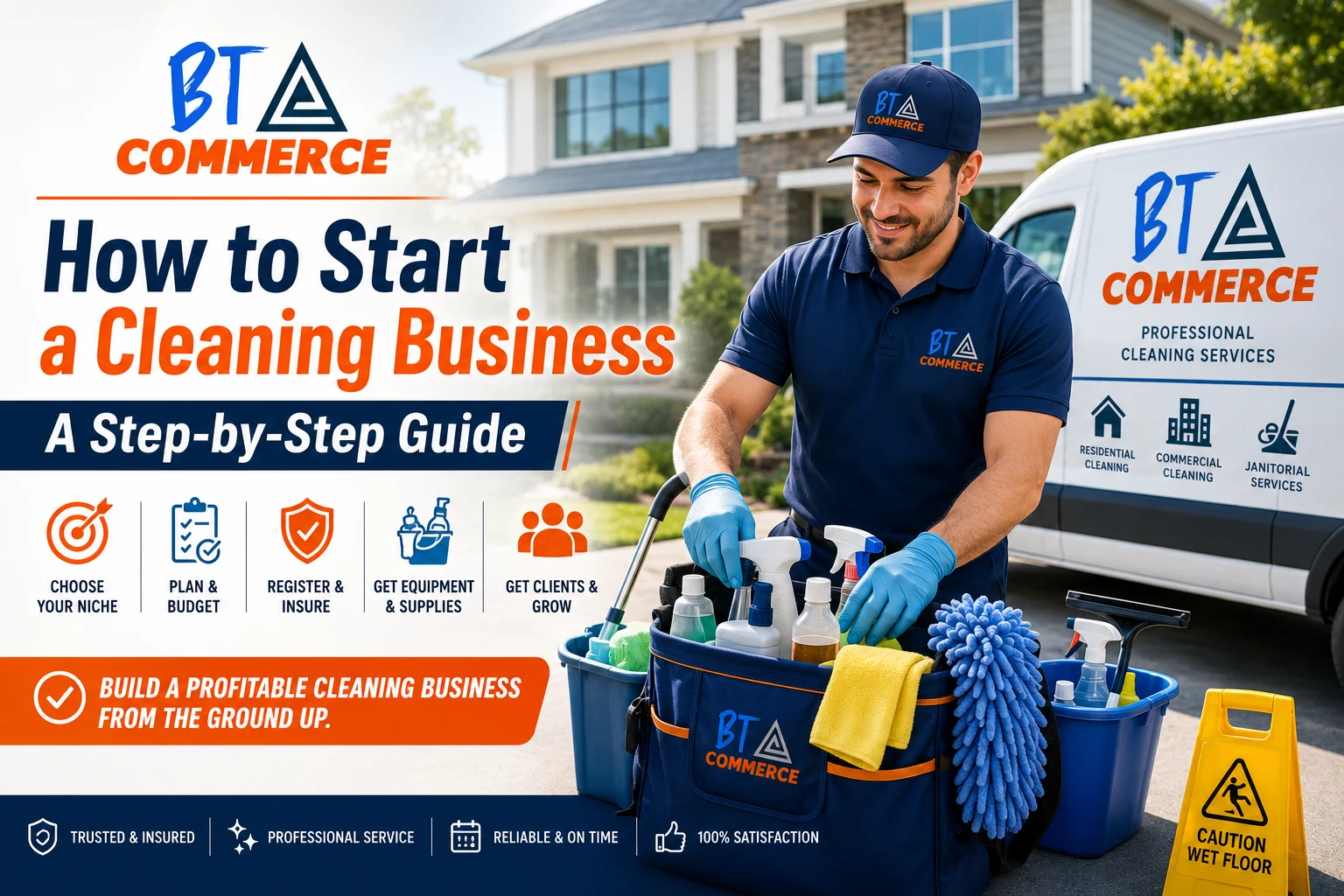
Starting a cleaning business is a practical way to build a business with relatively low startup costs and steady demand from both homeowners and businesses. Whether you plan to start, open, or grow a cleaning company, cleaning agency, residential cleaning service, or commercial cleaning business, this guide walks you through each step—from choosing a niche and registering your business to buying equipment, setting your prices, and finding your first customers.
Why Start a Cleaning Business?
The cleaning industry, including residential cleaning, commercial cleaning, and janitorial services, continues to grow due to steady demand from homeowners and businesses. With relatively low startup costs and opportunities for recurring revenue, starting a cleaning business allows you to begin small, gain experience, and grow over time.
- Demand stays strong year-round: Homes, apartments, offices, retail stores, and vacation rentals all need regular cleaning. This creates consistent opportunities whether you choose residential cleaning, commercial cleaning, or both.
- You don’t need a large upfront investment: Many entrepreneurs can launch a residential cleaning business with less than $1,000 by purchasing basic equipment, registering the business, and obtaining General Liability Insurance. Unlike many other businesses, you won’t need a storefront, expensive machinery, or large inventory to get started.
- Recurring clients create predictable income: Many customers schedule weekly, biweekly, or monthly cleaning services. Building a base of repeat clients gives you more stable cash flow and reduces the pressure to constantly find new jobs.
- You can build the business that fits your goals: Start as a solo cleaner, operate from home, or grow into a full cleaning company with employees. You can also specialize in office cleaning, janitorial services, or other niche markets as your business expands.
- Scaling becomes easier over time: Once you’ve built a strong reputation, you can expand your service area, add new services, hire a team, and secure long-term commercial contracts to increase your revenue.
Read more:
- 750+ Cleaning Business Name Ideas (Unique & Catchy Names)
- How to Start a Business in 10 Practical Steps to Succeed
- How to Start a Photography Business: A Step-by-Step Guide
How To Start a Cleaning Business: A Step-by-Step Guide
Step 1. Choose Your Cleaning Business Niche
A cleaning agency or company may offer multiple services, but starting with a focused niche helps you control costs, build expertise, and attract the right customers. It affects your startup costs, equipment, pricing, marketing strategy, and the types of clients you’ll target. While you can expand later, focusing on one niche makes it easier to build experience and win your first customers.
- Residential cleaning: Provides services for homes and apartments, including house cleaning, maid services, housekeeping, and move-in or move-out cleaning. It typically has the lowest startup costs and is the easiest option for beginners.
- Commercial cleaning: A commercial cleaning company serves offices, retail stores, schools, healthcare facilities, and other businesses. It often leads to higher-value recurring contracts, including contract cleaning services, but may require specialized equipment and stricter cleaning standards.
- Office cleaning: Focuses on maintaining workspaces, meeting rooms, restrooms, and common areas. Since many businesses require regular cleaning, it offers a steady source of recurring revenue.
- Janitorial services: Provides ongoing facility maintenance, such as trash removal, floor care, restroom sanitation, and supply restocking. These services are commonly delivered under long-term contracts.
- Specialty cleaning: Includes services such as move-out cleaning, Airbnb turnovers, post-construction cleanup, carpet cleaning, and window cleaning. Specializing can help you stand out and charge premium rates.
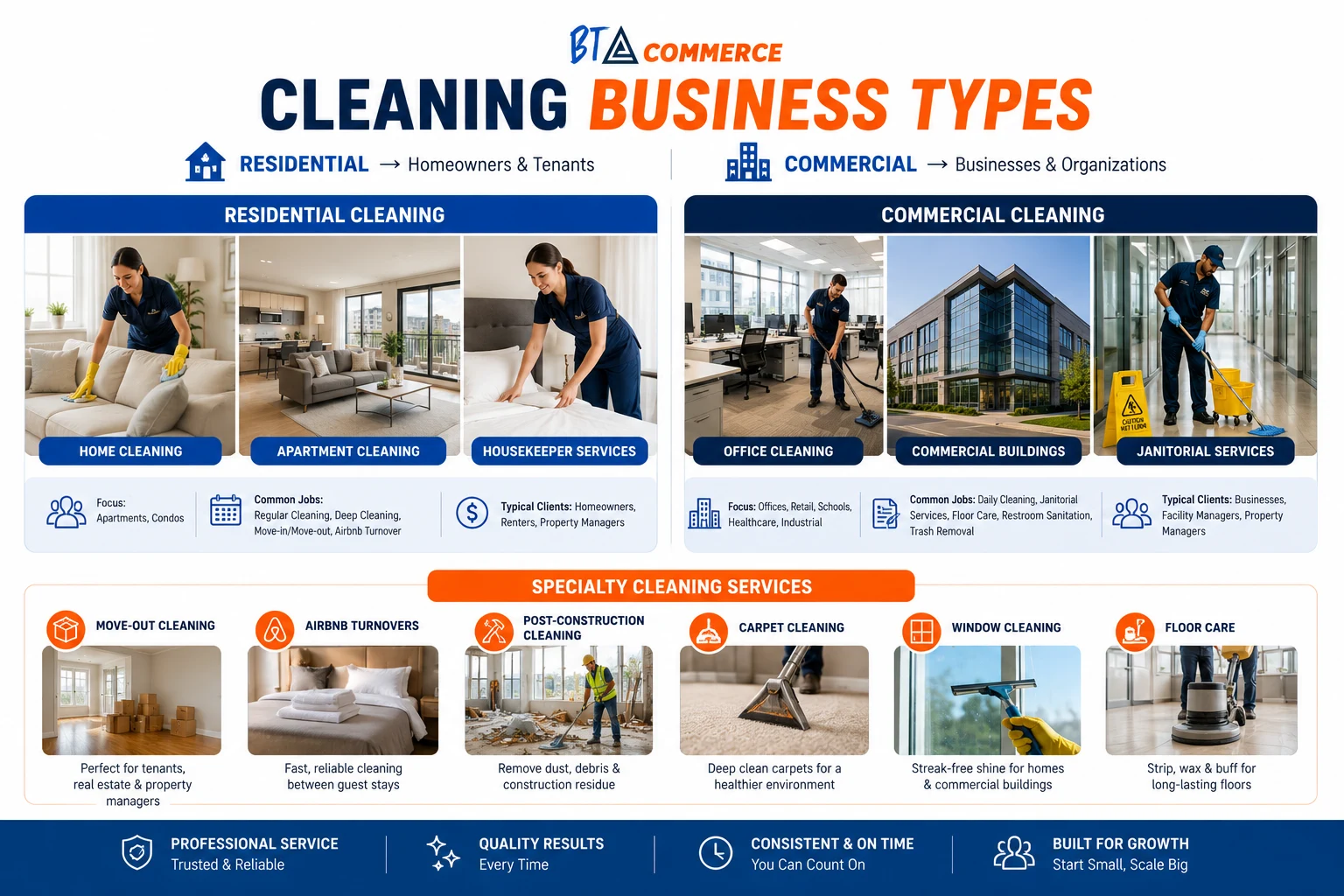
How to choose the right niche: Consider your experience, startup budget, and local demand. If you’re starting with limited capital, residential cleaning is usually the most practical choice. If you have business connections or experience serving companies, commercial cleaning or janitorial services may offer greater long-term growth.
=> Read more: Cleaning Business Ideas: 30 Profitable Cleaning Services to Start
Step 2. Research the Market
Before starting your cleaning business, research your local market to understand demand, competition, and customer expectations. This helps you identify opportunities before investing in equipment or marketing.
- Research the local market: Focus on specific neighborhoods instead of an entire city. Areas with high residential density, owner-occupied homes, and stable household incomes are more likely to generate recurring residential cleaning jobs. If you’re targeting commercial clients, look for business districts with offices, retail stores, and other facilities that regularly outsource cleaning services.
- Identify your target customers: Decide whether you’ll serve homeowners, property managers, Airbnb hosts, offices, or retail businesses. A clearly defined audience makes it much easier to market your services effectively.
- Analyze local competitors: Search Google for cleaning companies in your area and compare their services, pricing, customer reviews, and booking process. Requesting a few quotes can also help you understand local pricing and customer expectations.
- Find gaps in the market: Instead of competing on price alone, look for ways to offer a better customer experience or specialized services, such as online booking, eco-friendly cleaning, faster response times, or Airbnb turnover cleaning.
Step 3. Create Your Business Plan
A cleaning business plan turns your market research into a practical roadmap for launching and growing your cleaning company or agency. It should clearly define the services you’ll offer, your target customers, pricing strategy, financial projections, and business goals.
- Decide which cleaning services you’ll offer: Choose whether to focus on residential cleaning, commercial cleaning, janitorial services, housekeeping, or specialized services such as carpet cleaning, post-construction cleaning, or Airbnb turnover cleaning. A focused service list makes your business easier to position and market.
- Choose your target market and niche: Identify the customers you want to serve, such as homeowners, busy professionals, property managers, Airbnb hosts, or local businesses. Your niche and unique selling proposition (USP) should clearly explain why clients should choose your cleaning company over competitors.
- Define your pricing strategy: Decide whether to charge hourly, flat-rate, or per-square-foot based on your services and local market. Your pricing should cover operating costs while remaining competitive and profitable.
- Estimate startup costs and revenue: List your expected expenses, including business registration, equipment, insurance, software, and marketing. Then project your monthly revenue and calculate your break-even point to estimate when your business should become profitable.
- Set short- and long-term business goals: Establish measurable milestones, such as signing your first recurring clients, reaching a target monthly revenue, expanding into new service areas, or hiring employees as demand grows.
Step 4. Estimate Your Startup Costs
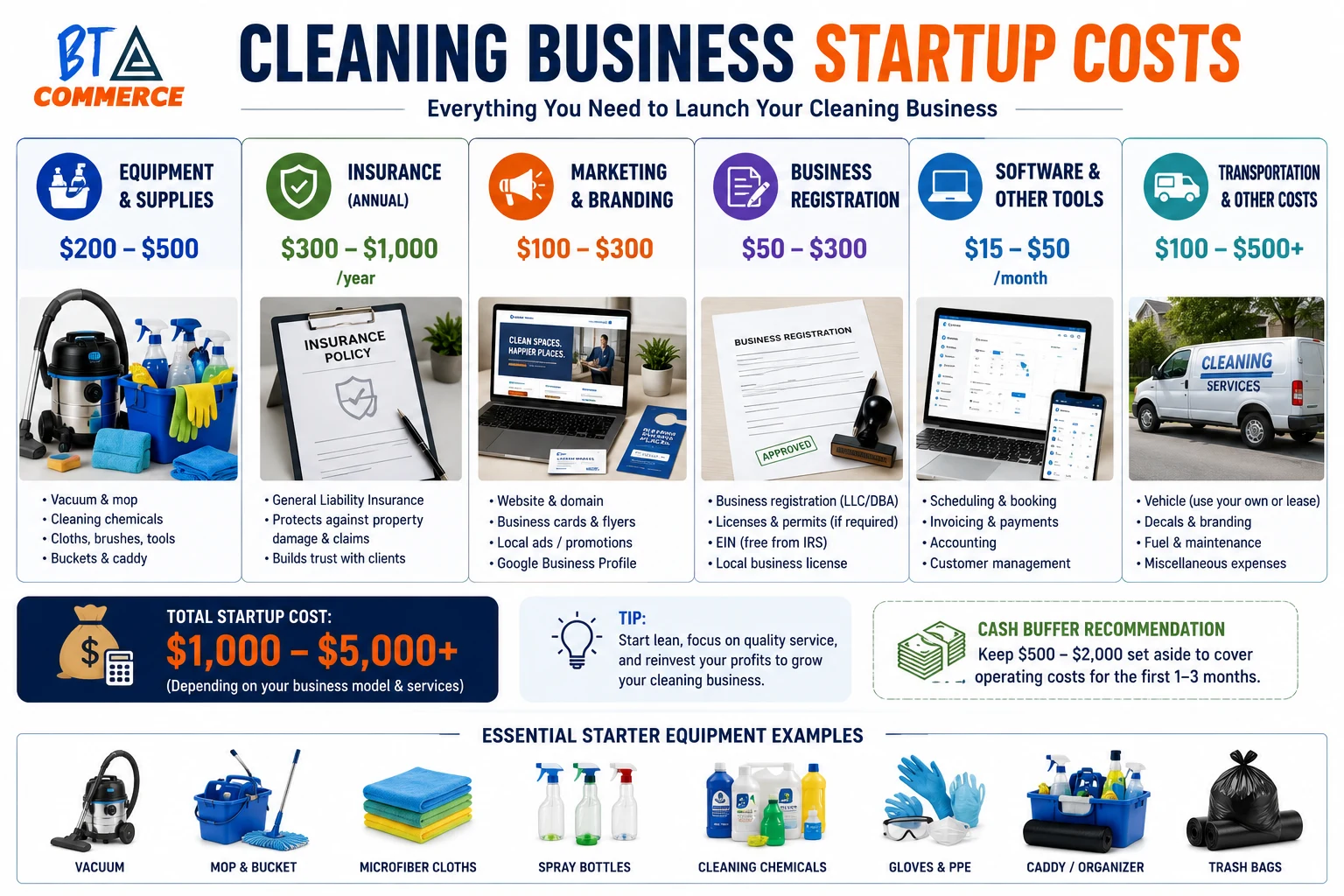
Understanding your cleaning business startup costs helps you estimate the investment required before launching. Residential cleaning businesses typically cost $1,000–$5,000 to launch, while commercial cleaning businesses often require $3,000–$5,000+ because of specialized equipment and larger operational needs.
- Business registration fees: Registering a Sole Proprietorship or LLC and obtaining any required local licenses or permits typically costs $50–$300, depending on your location.
- Equipment and supplies: Set aside $200–$500 for a residential cleaning business. Commercial cleaning businesses typically require a larger equipment budget, which can exceed $3,300.
- Transportation costs: Many new business owners start with a personal vehicle to reduce expenses. Budget around $100–$500 if you plan to add professional vehicle decals or other branding.
- Insurance: General Liability Insurance typically costs $300–$1,000 per year and protects your business against property damage and liability claims. Bonding is optional but is commonly requested by residential clients.
- Marketing expenses: Plan to spend $100–$300 on launch marketing, including a basic website, business cards, and flyers. After launch, many cleaning businesses invest $50–$200 per month in local digital advertising or lead-generation platforms.
- Software and other operating costs: Budget $15–$50 per month for scheduling, invoicing, accounting, or project management software. Free tools like Google Workspace and Wave Invoicing can help reduce expenses when starting out. It’s also recommended to keep a cash buffer of $500–$2,000 to cover operating costs during your first one to three months before recurring revenue becomes stable.
Step 5. Register Your Cleaning Business
Registering your cleaning business gives it a legal identity and helps protect your personal assets. While the exact requirements vary by location, most businesses follow the same registration process before serving clients.
- Choose a business structure: Your business structure affects taxes and liability. A Sole Proprietorship is the easiest to start but doesn’t protect your personal assets. An LLC (Limited Liability Company) is often the preferred choice because it separates your personal and business finances. Larger businesses may choose a Corporation (C-Corp or S-Corp) as they grow.
- Choose and register your business name: After selecting a business name, register it with the appropriate authority. If you operate as an LLC or Corporation, you’ll register your entity with your state’s Secretary of State. Sole proprietors using a different trading name may also need to register a DBA (Doing Business As).
- Obtain licenses and permits (if required): Licensing requirements vary by city, county, and state. Many cleaning businesses need a General Business License, while specialized services such as pressure washing, biohazard cleanup, or hazardous waste removal may require additional permits.
- Get an Employer Identification Number (EIN) and open a business bank account: An EIN is a federal tax ID issued by the IRS and is typically required for hiring employees, filing taxes, and opening a business bank account. Keeping business and personal finances separate makes accounting and tax reporting much easier.
- Purchase business insurance: General Liability Insurance helps protect your business against property damage, accidents, and customer claims. Depending on your services and local regulations, you may also consider bonding or additional insurance as your cleaning business grows.
Step 6. Buy the Right Equipment and Supplies
Once you’ve set your budget, the next step is purchasing the equipment you’ll use every day. Start with a commercial-grade starter kit that covers most residential and light commercial jobs, and avoid buying expensive specialty machines until you have clients who need those services.
- Essential cleaning supplies: A reliable vacuum cleaner, microfiber flat mop and bucket, broom, dustpan, extendable duster, spray bottles, and high-quality microfiber cloths. Many professional cleaners use color-coded microfiber cloths to prevent cross-contamination—for example, blue for glass and green for bathrooms.
- Cleaning chemicals: Stock a concentrated all-purpose cleaner, glass cleaner, bathroom cleaner or degreaser, and a hospital-grade disinfectant. Clearly label all spray bottles and dilute concentrated products according to the manufacturer’s instructions to reduce costs.
- Safety gear: Keep nitrile or rubber gloves, shoe covers, and safety glasses on hand when working with stronger cleaning chemicals or commercial jobs.
- Transportation and storage: Use a divided cleaning caddy or cart to organize supplies and move efficiently between rooms. Buying cleaning solutions in bulk can further reduce operating costs over time.
- Business software and scheduling tools: Use scheduling, invoicing, and customer management software to stay organized as your business grows. Many new cleaning businesses start with free or low-cost tools before upgrading to more advanced platforms.
If you plan to offer post-construction cleaning, carpet cleaning, or floor care, consider renting specialized equipment such as floor scrubbers, floor buffers, or pressure washers until demand justifies purchasing your own. This approach keeps your upfront investment low while allowing you to expand your services over time.
Step 7. Set Your Cleaning Service Prices
Setting the right price helps your cleaning business stay profitable while remaining competitive. Base your rates on your actual operating costs, local market conditions, and the value you provide rather than simply charging less than competitors.
- Calculate your operating costs: Before setting prices, determine your break-even point by adding up expenses such as cleaning supplies, fuel, vehicle maintenance, General Liability Insurance, marketing, software, and labor. If you work alone, include a reasonable hourly wage for yourself.
- Research competitor pricing: Compare 5–10 local cleaning companies offering similar services. Pay attention to their pricing, service packages, add-on fees, promotions, and guarantees to understand where your business fits in the local market.
- Choose a pricing model: Select the model that best matches your services.
- Hourly rate: Best for one-time, deep cleaning, or move-in/move-out jobs where the workload is difficult to predict. Many cleaners charge around $50 per hour per cleaner.
- Flat rate: Common for recurring residential cleaning because customers know the total price upfront. A standard cleaning for a 2,000-square-foot home often ranges from $200–$400, while deep cleaning typically costs $240–$500.
- Per square foot: Commonly used for commercial and office cleaning, with rates typically ranging from $0.05–$0.20 per square foot, depending on the facility and cleaning frequency.
- Adjust prices based on each job: Consider factors such as property size, service frequency, job complexity, and any additional services requested. Recurring weekly or bi-weekly cleanings are often priced lower per visit than one-time appointments because they provide more predictable revenue.
- Provide professional estimates: Send an itemized quote that clearly lists the cleaning tasks, service frequency, total price, and your business information. Review your pricing regularly and adjust it as labor, supply, or operating costs change.
Step 8. Market Your Business and Get Your First Clients
Even if you offer excellent cleaning services, customers won’t hire you if they can’t find your business. Focus on local marketing first, build credibility, and encourage repeat customers before investing heavily in paid advertising.
- Create a professional website: Include your services, service area, pricing information (or request-a-quote form), contact details, and customer testimonials. A simple, mobile-friendly website helps build trust and makes it easier for potential clients to contact you.
- Set up your Google Business Profile: A Google Business Profile helps your cleaning business appear in Google Search and Google Maps for local searches. Complete your profile with business hours, service areas, photos, and contact information, then ask your first customers to leave honest reviews.
- Use social media and local directories: Promote your business through Facebook, Nextdoor, and local community groups where homeowners often look for cleaning services. You can also post free listings on platforms like Craigslist to generate early leads without a large marketing budget.
- Ask for referrals and customer reviews: Word-of-mouth is one of the most effective ways to grow a cleaning business. Encourage satisfied customers, friends, and family to recommend your services, and consider offering referral incentives to generate more bookings.
- Partner with local businesses: Build relationships with property managers, real estate agents, and carpet cleaning companies. These businesses frequently need reliable partners for move-in, move-out, post-sale, or recurring cleaning services.
- Build recurring customer relationships: Long-term clients provide predictable revenue and lower your marketing costs. Deliver consistent service, communicate professionally, and follow up after each job to encourage weekly, bi-weekly, or monthly cleaning appointments.
Step 9. Manage and Grow Your Cleaning Business
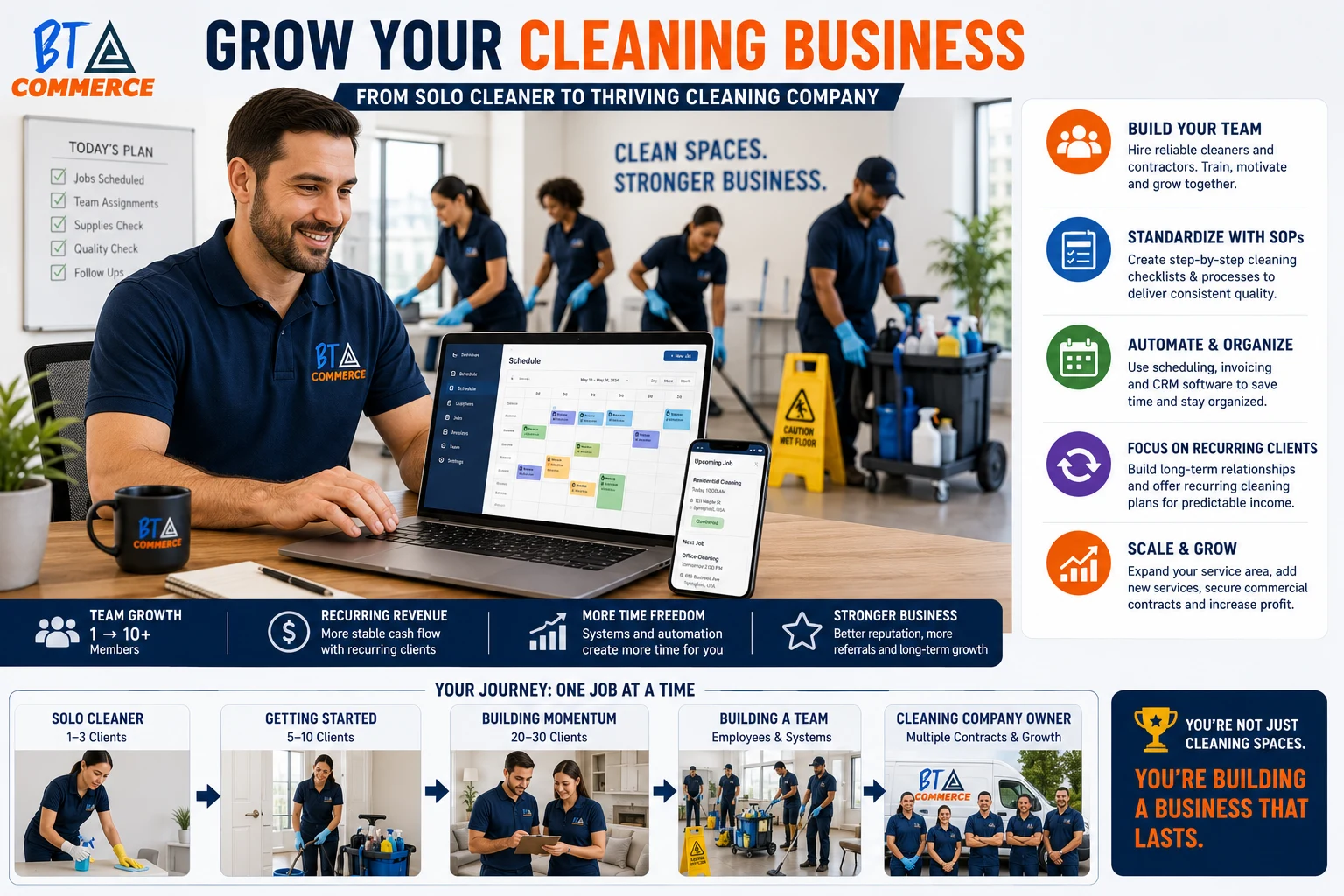
Many successful cleaning agencies grow by building teams of cleaners, managing recurring contracts, and creating systems that allow the owner to focus on operations instead of every individual cleaning job. Standardized operations, recurring customers, and automation make it easier to scale without sacrificing service quality.
- Hire employees when demand increases: If you’re turning away jobs or your schedule is consistently full, consider hiring employees or 1099 contractors. Use a structured hiring process that includes interviews, background checks, and clear onboarding procedures.
- Train your team and maintain service quality: Create standard operating procedures (SOPs) for every cleaning job so customers receive a consistent experience regardless of who performs the work. Regular quality checks and customer feedback help protect your reputation.
- Standardize your operations: Document workflows for scheduling, cleaning checklists, customer communication, and follow-up. Using consistent processes makes it easier to train new team members and reduce operational errors.
- Expand your service area or add new services: As your business grows, consider serving additional neighborhoods or offering higher-value services such as carpet cleaning, window cleaning, or post-construction cleaning. You can also pursue commercial janitorial contracts, which often provide stable recurring revenue.
- Automate scheduling, invoicing, and customer relationship management (CRM): Use software such as BookingKoala for online booking and scheduling, or platforms like CleanWorks to manage customer communication, invoicing, and follow-up. Automation reduces administrative work and allows you to handle more clients efficiently.
- Increase customer retention and recurring revenue: Retaining existing customers is usually more cost-effective than finding new ones. Stay in touch with past clients, encourage referrals with simple incentives, and promote weekly, bi-weekly, or monthly cleaning plans to build predictable recurring income.
Common Mistakes to Avoid When Starting a Cleaning Business
Common mistakes can slow down your cleaning business growth, reduce profitability, and create operational problems. Avoiding these issues early helps you build a stronger foundation and scale more effectively.
- Choosing the wrong niche: Trying to serve everyone from the beginning can make your marketing less effective. Focus on a specific segment, such as residential cleaning, commercial cleaning, or specialty services, based on local demand and your resources.
- Underpricing your services: Low prices may help you get initial clients, but they can quickly reduce your profit margins. Make sure your pricing covers supplies, insurance, labor, and other operating costs.
- Buying unnecessary equipment too early: Avoid investing in expensive machines before you have customers who need those services. Start with essential equipment and upgrade as your business grows.
- Ignoring insurance or legal requirements: Operating without proper registration, licenses, or General Liability Insurance can expose your business to financial risks and damage your reputation.
- Inconsistent marketing: Many cleaning businesses struggle because they only look for customers when sales are low. Maintain regular marketing through channels like your website, Google Business Profile, referrals, and local partnerships.
- Focusing only on new customers: Acquiring new clients is important, but repeat customers create more predictable revenue. Build relationships, encourage reviews, and offer recurring cleaning plans to improve retention.
Starting a Cleaning Business FAQs
What Do I Need to Start a Cleaning Business?
To start a cleaning business, house cleaning business, or cleaning agency, you’ll need to choose a niche, register your business, obtain any required licenses and insurance, purchase essential cleaning equipment, and create a plan for pricing and marketing your services. A reliable vehicle is also helpful if you’ll travel to clients’ locations.
How Much Does It Cost to Start a Cleaning Business?
Most residential cleaning businesses can be started with $1,000 to $5,000, depending on your location and the services you offer. The largest startup expenses typically include cleaning equipment and supplies, business registration, insurance, transportation, and initial marketing.
Can I Start a Cleaning Business From Home?
Yes. Many cleaning businesses start from home to keep overhead costs low. You can store equipment at home, manage bookings and customer communication remotely, and travel directly to clients instead of renting office space.
How Do Commercial and Residential Cleaning Businesses Differ?
Residential cleaning focuses on homes and apartments, making it easier and less expensive to start. Commercial cleaning serves offices, retail spaces, and other businesses, often requiring specialized equipment, larger contracts, and after-hours work, but it also offers greater opportunities for recurring revenue.
How Profitable Is a Cleaning Business?
A cleaning business can be highly profitable when managed efficiently. Many established businesses achieve 20% to 30% profit margins, with profitability increasing as you build a loyal client base, secure recurring contracts, and expand your team or service offerings.
Recommended Reading